
SLA Management in ITSM: Evolution, Metrics and Ai-Driven ITIL 5
Introduction
Service Level Agreement (SLA) Management has evolved far beyond static contractual obligations. It is now a dynamic performance management discipline that directly impacts customer experience, operational efficiency, and business outcomes.
Organizations are no longer asking, “Are we meeting SLAs?”
They are asking, “Are our SLAs driving business value?”
Modern organizations are no longer satisfied with simply tracking SLA compliance. They are asking deeper questions:
- Are SLAs aligned with business priorities?
- Are metrics driving meaningful improvements?
- Can SLA management be predictive rather than reactive?
With the emergence of AI-driven ITSM and the evolution toward ITIL 5, SLA Management in ITSM is transitioning into a data-driven, intelligent, and outcome-focused discipline.
This article explores:
- SLA best practices
- Deep focus on metrics (core + advanced)
- A practical SLA example
- ITIL 4 vs ITIL 5 evolution
- AI-driven SLA transformation
- Cost optimization insights
What is SLA Management in ITSM?
SLA Management in ITSM ensures that IT services are delivered as per agreed performance targets covering response times, resolution times, availability, and user experience.
However, modern SLA management is not just about compliance. It is about:
- Visibility
- Accountability
- Continuous improvement
- Business alignment
Best Practices in SLA Management in ITSM
Effective SLA Management requires:
1. Business-Aligned SLAs
Avoid purely technical SLAs. Focus on:
- Business impact
- User outcomes
- Service value
2. Clear Service Definitions
Tie SLAs directly to:
- Service Catalog
- Service Request Management
3. Tiered SLAs
Different SLAs for:
- Critical services
- Standard services
- Low-priority services
4. Governance Model
Define:
- Owners
- Escalation paths
- Review cadence
5. Continuous Review
- Weekly operational reviews
- Monthly SLA compliance reviews
- Quarterly improvement cycles
SLA Metrics: The Core of SLA Management in ITSM
Why Metrics Matter
Without metrics, SLAs become:
Static documents with no operational impact.
Metrics convert SLAs into:
- Measurable performance
- Actionable insights
- Continuous improvement in drivers
Core SLA Metrics (Foundation Layer)
1. Response Time
Time taken to acknowledge a request.
Why it matters:
- First impression of IT
- Drives user satisfaction
2. Resolution Time (MTTR)
Mean Time to Resolve an issue.
Why it matters:
- Measures efficiency
- Impacts business downtime
3. SLA Compliance %
% of tickets meeting SLA targets.
Formula:
(Tickets within SLA / Total tickets) × 100
4. First Contact Resolution (FCR)
Tickets resolved without escalation.
Why it matters:
- Indicates maturity of support teams
- Reduces cost per ticket
5. Service Availability
System uptime vs downtime.
Example:
- 99.9% uptime = ~8.76 hours downtime/year
6. Customer Satisfaction (CSAT)
User feedback score.
Why it matters:
- Captures experience (not just performance)
Advanced SLA Metrics (Maturity Layer)
As organizations mature, they move beyond operational metrics.
🔹 Cost per Ticket
Tracks financial efficiency
🔹 Reopen Rate
Indicates quality of resolution
🔹 Automation Rate
% of tickets resolved automatically
🔹 SLA Breach Prediction Rate
AI-driven metric for proactive management
🔹Experience Level Agreements (XLAs)
Focus on:
- User perception
- Business impact
Sample SLA (Scrumbyte Reference Model)
Service: Email Support
| Parameter | Target |
| Service Hours | 24×7 |
| Response Time | ≤ 15 minutes |
| Resolution Time | ≤ 4 hours |
| Availability | 99.9% |
| FCR | ≥ 70% |
| CSAT | ≥ 4.5/5 |
Escalation Model
| Level | Timeline |
| L1 | 0–30 mins |
| L2 | 30–120 mins |
| L3 | 2+ hours |
Reporting Cadence
- Daily dashboards
- Weekly reviews
- Monthly SLA reports
ITIL 4 vs ITIL 5: SLA Management in ITSM Evolution
ITIL 4 Approach
ITIL 4 introduced:
- Service Value System (SVS)
- Co-creation of value
- Experience focus (XLAs)
SLA Management became:
- Less rigid
- More outcome-oriented
ITIL 5 Evolution (Next-Gen ITSM)
ITIL 5 builds on ITIL 4 with:
- Predictive insights
- Autonomous decision-making
🔹 Real-Time Metrics
- Live dashboards
- Continuous monitoring
- Focus on user journeys
🔹 Integrated Ecosystems
- DevOps + ITSM + Observability
AI in SLA Management: Transformational Shift
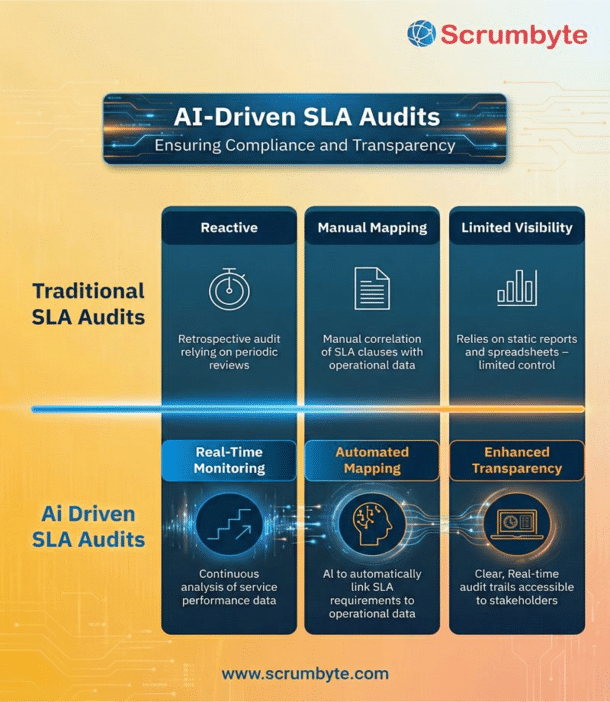
AI is redefining SLA Management in ITSM from:
Reactive → Predictive → Autonomous
AI-Powered SLA Capabilities
1. Predictive SLA Breach Detection
- Flags tickets likely to breach SLAs
- Enables proactive action
2. Intelligent Ticket Routing
- Auto-classification
- Skill-based assignment
3. Dynamic SLA Adjustments
- Based on:
- Workload
- Priority
- Historical patterns
4. Root Cause Analytics
- Identifies recurring SLA failures
5. Real-Time Compliance Monitoring
- Alerts before breach occurs
How AI Reduces Costs in SLA Management in ITSM
1. Reduced Manual Effort
- Automation of ticket handling
- Chatbots for L1 support
2. Fewer SLA Breaches
- Avoid penalties
- Improve trust
3. Faster Resolution Times
- Reduced MTTR
- Increased productivity
4. Optimized Resource Allocation
- Right skill → right ticket
5. Lower Ticket Volumes
- Self-service
- Knowledge automation
SLA Metrics Framework (Scrumbyte Model)
Operational Metrics → Performance Metrics → Experience Metrics → Predictive Metrics
| Layer | Metrics |
| Operational | Response, Resolution |
| Performance | SLA %, Availability |
| Experience | CSAT, XLA |
| Predictive | Breach prediction, AI insights |
Future Trends in SLA Management in ITSM
🔹 SLA → XLA Shift
Focus on experience, not just performance
🔹 Autonomous ITSM
AI-driven workflows with minimal human intervention
🔹 Real-Time Decision Systems
Dashboards become decision engines
🔹 DevOps Integration
SLA + Deployment + Monitoring
🔹 Outcome-Based SLAs
Aligned to:
- Revenue
- Productivity
- Business KPIs
Final Thought
SLA Management is no longer about:
“Meeting targets”
It is about:
“Driving outcomes, experiences, and continuous value”
With:
- Metrics as the foundation
- AI as the accelerator
- ITIL 5 as the direction
Organizations that modernize SLA Management will move from:
Service Delivery → Service Excellence → Experience Leadership
At Scrumbyte, we help organizations design and implement:
- SLA frameworks aligned to ITIL 4 & ITIL 5
- KPI-driven reporting models
- AI-enabled service management ecosystems
ServiceNow Features for SLA Management in ITSM.
If you are using ServiceNow as your platform, you may consider the following.
SLA Management in ITSM, in ServiceNow is highly mature and tightly integrated with core ITSM processes, enabling organizations to define, monitor, and enforce service commitments with precision. At the heart of this capability are SLA Definitions, where you can configure conditions such as priority, category, or assignment group to automatically attach SLAs to records like incidents or service requests.
For example, a Priority 1 Incident can be configured with a response SLA of 15 minutes and a resolution SLA of 4 hours. These SLAs are tracked in real time using Task SLA records, which monitor elapsed time, pause conditions (such as “Waiting for Customer”), and breach status. ServiceNow also provides SLA Engine controls that allow pausing, resetting, or canceling SLAs dynamically based on workflow changes, ensuring accurate measurement aligned to real operational states.
Another powerful feature is SLA Visualization and Monitoring, delivered through dashboards and reports such as SLA compliance trends, breach analysis, and time-to-resolution metrics. For instance, a service desk manager can view a dashboard showing all incidents at risk of breaching SLAs within the next hour, enabling proactive intervention.
Additionally, Workflow and Flow Designer integration allows automation such as escalating tickets nearing breach, notifying stakeholders, or reassigning tasks to higher-skilled teams. With Performance Analytics, organizations can track historical SLA performance, identify recurring bottlenecks, and forecast future trends. More advanced implementations leverage Predictive Intelligence to anticipate SLA breaches and recommend actions, such as prioritizing specific tickets or allocating resources differently, thereby shifting SLA management from reactive tracking to proactive and predictive control.
Missing SLAs and Struggling with Service Accountability?
When SLAs are poorly defined, not aligned with business priorities, or lack visibility, it leads to missed targets, unhappy users, and no clear accountability. The issue is often weak SLA design and tracking – not team performance.
How Scrumbyte Helps
Our ITSM Consulting Services and SLA Management Consulting Services focus on designing measurable, business-aligned SLAs and improving service performance.
- SLA Framework Design & Optimization for clear, realistic targets
- SLA Management in ServiceNow ITSM Implementation aligned with workflows
- KPI & Reporting Setup for real-time SLA visibility
- SLA Process Standardization across ITSM practices
Improved SLA compliance, better service visibility, and stronger accountability across IT teams
Looking to modernize your SLA Management in ITSM?
Connect with us to build a future-ready, metrics-driven ITSM capability.

Vijay Chander is the founder of Scrumbyte, and is a senior IT strategy and service management consultant with over 30 years of global experience across Fortune 100 organizations including Microsoft, Caterpillar, First Data and SWIFT. He has led large-scale enterprise transformations spanning ITSM, architecture, product development, and managed services
Comments are closed