
Introduction
IT services are expected to operate with near-perfect reliability, rapid response times, and measurable business outcomes. Customers no longer tolerate prolonged outages, delayed responses, or inconsistent service experiences. As organizations increasingly depend on digital platforms for business continuity, Service Level Agreements (SLAs) have become critical indicators of operational maturity and customer trust.
However, traditional SLA management approaches are often reactive. Most organizations wait for SLA breaches to occur before taking corrective action. By the time alerts are triggered, escalation begins, or management reviews take place, the business impact has already occurred. SLA monitoring to detect and prevent becomes very important in this context and we explore it in this post.
Aligned with ITIL 4 principles, modern ITSM organizations are now moving toward predictive SLA breach detection and prevention models. These approaches use automation, analytics, CMDB-driven insights, event correlation, AI-based risk scoring, and continual improvement practices to identify SLA risks before breaches occur.
Predictive SLA management transforms ITSM from reactive firefighting into proactive service assurance.
In this blog, we explore how organizations can implement predictive SLA management aligned to ITIL 4 value streams, with practical examples, data points, and operational insights.
Why Predictive SLA Management is important?
Traditional ITSM environments are heavily focused on SLA monitoring, focusing more on compliance percentages after incidents are resolved. While metrics like “92% SLA compliance” may appear healthy, they often fail to reveal underlying operational inefficiencies.
For example:
- A bank may achieve 95% SLA compliance but still receive poor customer satisfaction ratings because users experience repeated disruptions.
- An IT support team may technically resolve incidents within SLA targets but rely heavily on emergency escalations and overtime effort.
- A healthcare organization may experience SLA breaches only during weekends due to reduced staffing and delayed vendor support.
Predictive SLA management focuses on:
- Detecting early warning signals
- Identifying SLA breach patterns
- Preventing SLA failures before customer impact occurs
- Improving ITSM operational efficiency and service experience
Organizations implementing predictive SLA management typically achieve:
| Improvement Area | Typical Improvement |
|---|---|
| SLA Breach Reduction | 30–50% |
| MTTR Reduction | 20–40% |
| Customer Satisfaction | Significant increase |
| Operational Efficiency | Improved resource utilization |
| Escalation Volume | Reduced by 25–35% |
ITIL 4 and Predictive SLA Management
In ITIL 4, Service Level Management is not just about measuring compliance. It is about enabling value co-creation through continuous improvement, operational visibility, and proactive service assurance.
Predictive SLA management maps strongly to ITIL 4 value streams.
| ITIL 4 Stage | Predictive Capability |
|---|---|
| Engage | Early alerts, proactive escalation |
| Deliver & Support | AI risk scoring, auto-assignment |
| Design & Transition | Workflow optimization |
| Improve | Pattern analysis and CSI integration |
This integration ensures SLA management becomes part of an end-to-end operational intelligence framework rather than just a reporting mechanism.
Predictive SLA Breach Detection (Early Warning Signals)
1. Real-Time SLA Burn Rate Monitoring
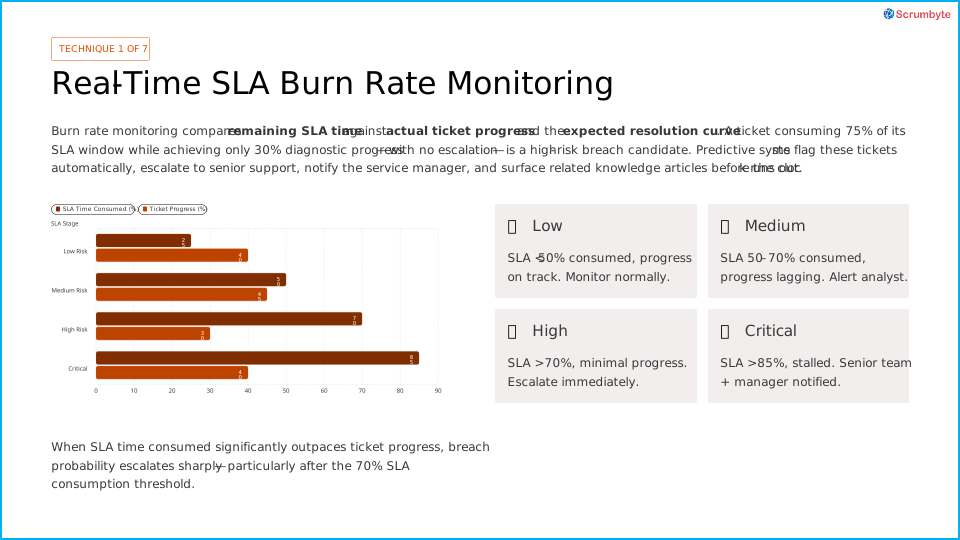
One of the most effective predictive techniques is SLA burn rate monitoring which is a part of SLA monitoring.
Instead of only tracking elapsed SLA time, organizations compare:
- Remaining SLA time
- Current ticket progress
- Expected resolution curve
Example Scenario
A Priority 2 incident has a 4-hour SLA.
After 3 hours:
- 75% SLA time consumed
- Only 30% diagnostic progress completed
- No escalation initiated
This ticket becomes a high-risk candidate for SLA breach.
A predictive system automatically:
- Flags the ticket
- Escalates to senior support
- Notifies the service manager
- Suggests related knowledge articles
Sample Data for Graphs
| SLA Time Consumed | Ticket Progress | Risk Level |
|---|---|---|
| 25% | 40% | Low |
| 50% | 45% | Medium |
| 70% | 30% | High |
| 85% | 40% | Critical |
2. Historical Pattern-Based Prediction

ITSM platforms contain years of incident data that can be analyzed for SLA breach trends which is a part of SLA monitoring.
Organizations can identify:
- Categories with high breach probability
- Time-of-day trends
- Day-of-week patterns
- Seasonal spikes
- Teams with recurring delays
Real-World Example
A financial services organization analyzed 12 months of incident data and discovered:
- Network-related incidents on weekends had a 2x higher breach probability
- Vendor response delays contributed to 40% of weekend SLA failures
- Staffing levels reduced by 35% during off-hours
Based on this insight:
- Weekend staffing was increased
- Vendor escalation rules were automated
- SLA breaches reduced by 28% in 3 months
Sample Data
| Day | Breach Rate |
|---|---|
| Monday | 8% |
| Tuesday | 7% |
| Wednesday | 6% |
| Thursday | 9% |
| Friday | 11% |
| Saturday | 18% |
| Sunday | 17% |
3. AI and Machine Learning Risk Scoring
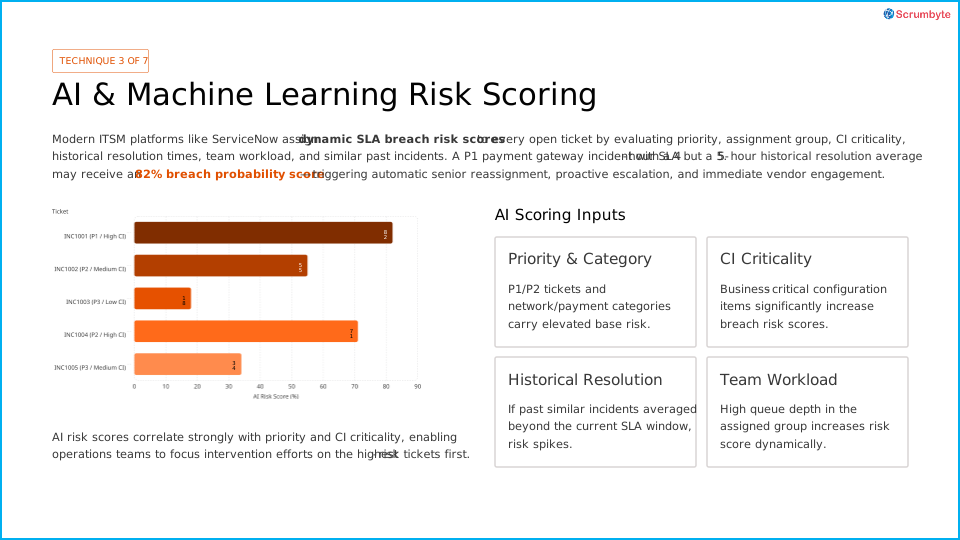
Modern ITSM platforms such as ServiceNow increasingly leverage AI and machine learning to assign dynamic SLA breach risk scores which is a part of SLA monitoring.
Tickets are evaluated based on:
- Priority
- Assignment group
- CI criticality
- Historical resolution time
- Team workload
- Similar past incidents
Example
A ticket involving a payment gateway receives:
- Priority: P1
- CI Criticality: High
- Historical resolution average: 5.5 hours
- Current SLA: 4 hours
The AI engine assigns:
SLA Breach Probability: 82%
The system automatically:
- Reassigns the ticket to a senior team
- Triggers proactive escalation
- Engages vendor support immediately
Sample Risk Score Data
| Ticket | Priority | Criticality | Risk Score |
|---|---|---|---|
| INC1001 | P1 | High | 82% |
| INC1002 | P2 | Medium | 55% |
| INC1003 | P3 | Low | 18% |
4. Queue and Workload Analysis

Many SLA breaches occur because of operational overload rather than technical complexity of which Queue and workload analysis is a part of SLA monitoring.
Organizations should continuously monitor:
- Queue backlog
- Tickets per analyst
- Open P1/P2 volume
- Average resolution time per team
Example
A service desk team of 10 analysts normally handles:
- 120 tickets/day
During a major rollout:
- Ticket volume increases to 240/day
- Tickets per analyst exceed threshold limits
- SLA breach probability increases sharply
The system detects the spike and automatically:
- Redistributes tickets
- Activates backup support teams
- Reprioritizes lower-impact requests
Example Metrics
| Tickets per Analyst | Breach Risk |
|---|---|
| 10–15 | Low |
| 16–20 | Medium |
| 21–30 | High |
| 30+ | Critical |
5. CMDB-Driven Dependency Risk Detection

A mature CMDB enables predictive SLA management by identifying dependency-related risks, which very essential for SLA Monitoring.
For example:
A payment application depends on:
- Application server
- Database cluster
- API gateway
- Network infrastructure
If one component degrades:
- SLA risk increases across the entire service chain
Real Example
A bank identified that:
- 60% of payment-related SLA breaches originated from database latency issues
- Most incidents occurred during batch processing windows
Using CMDB relationships:
- Monitoring thresholds were optimized
- Database scaling was automated
- P1 incidents reduced by 35%
6. Vendor Performance Monitoring

Third-party support contracts are often major contributors to SLA breaches an is very important part of SLA Monitoring that is often overlooked.
Organizations should monitor:
- Vendor response times
- Escalation delays
- Repeat delays by vendor category
Example
A telecom organization discovered:
- Network vendor response average: 3.5 hours
- SLA expectation: 1 hour
This mismatch caused:
- 42% of critical SLA breaches
After implementing vendor escalation automation:
- Breaches reduced to 18%
Sample Data
| Vendor | Avg Response | SLA Target | Breach Contribution |
|---|---|---|---|
| Vendor A | 45 mins | 1 hr | 12% |
| Vendor B | 3.5 hrs | 1 hr | 42% |
7. Event Correlation and Early Incident Signals

Modern monitoring platforms can detect performance degradation before incidents are logged. These automated mechanisms enhance SLA Monitoring.
Examples include:
- CPU spikes
- Memory exhaustion
- Repeated application alerts
- Database latency increases
Example
A retail organization detected:
- Repeated API latency alerts 30 minutes before checkout failures occurred
The system automatically:
- Restarted affected services
- Cleared transaction queues
- Prevented customer-facing outages
Result
- Zero SLA breaches during peak shopping hours
Predictive SLA Breach Prevention Mechanisms
1. Dynamic Auto-Prioritization
Tickets are automatically reprioritized based on:
- Business impact
- Risk score
- Service criticality
Example
A payroll outage during salary processing receives automatic escalation to Priority 1. For SLA monitoring it is essential that the correct priorities are pre-defined along with the specific use cases.
2. Intelligent Auto-Assignment
Instead of manual routing, tickets are assigned to:
- Best-performing teams
- Analysts with lower workloads
- Specialists with similar resolution history
Organizations implementing intelligent routing which is part of the automated SLA Monitoring often improve:
| Metric | Improvement |
|---|---|
| First-Time Resolution | 20–30% |
| MTTR | 25% |
| Escalations | Reduced significantly |
3. Proactive Escalation Rules
Escalation occurs automatically when:
- 50% SLA time consumed
- No ticket update within defined interval
- AI risk score exceeds threshold
This prevents silent ticket aging, one of the most common causes of SLA breaches.
4. Automated Remediation (Self-Healing)
Self-healing automation uses scripts and runbooks to resolve issues automatically. These SLA Monitoring tools are normally available in enterprise level soft like ServiceNow, however if you do not have it, you can create your own automation scripts for this self healing.
Examples
- Restart failed services
- Clear memory queues
- Reconnect failed integrations
A manufacturing organization implemented automated remediation for server alerts and achieved:
| KPI | Improvement |
|---|---|
| P2 Incidents | Reduced by 40% |
| SLA Breaches | Reduced by 55% |
5. Knowledge-Based Resolution Suggestions
Knowledge management improves SLA performance by recommending the following, and SLA monitoring in this case ensures that the Knowledge base is up-to date as part of due-diligence:
- Similar incident resolutions
- Known error fixes
- Standard troubleshooting procedures
This significantly improves:
- First-call resolution
- Analyst efficiency
- Consistency of support
6. SLA-Aware Workflow Adjustments
Organizations can dynamically modify workflows based on SLA risk. The key for SLA monitoring in these case is that there has to be clearly defined workflows and path on commonly encountered use cases and would be build-up over time by using Knowledge management.
Examples
- Skip non-critical approvals
- Fast-track high-risk tickets
- Prioritize business-critical incidents
7. Vendor Escalation Automation
The system automatically notifies vendors when:
- SLA risk threshold crossed
- Vendor response delay detected
Notifications include:
- SLA countdown
- Business impact
- Escalation priority
8. Capacity Rebalancing
Predictive systems detect workload spikes and redistribute support capacity dynamically as part of regular SLA Monitoring.
Examples
- Activating backup teams
- Cross-region ticket routing
- Temporary automation rules
9. Predictive Change Risk Integration
Predictive SLA management integrates closely with Change Enablement and this integration is also part of the overall framework of SLA monitoring.
Organizations can:
- Delay high-risk changes
- Block deployments during peak periods
- Predict change-related SLA impacts
10. Continuous Feedback Loop (CSI Integration)
ITIL 4 emphasizes continual improvement as a core principle.
Predictive SLA management feeds operational intelligence into:
- Problem Management
- Change Enablement
- Improvement backlogs
- Governance reviews
Organizations should continuously review:
- Top breach categories
- Repeat incidents
- Vendor performance
- Team productivity
- Automation effectiveness
This creates a feedback loop that improves operational maturity over time and thereby fortifying SLA Monitoring as an integrator and feeding it into knowledge management.
End-to-End Predictive SLA Scenario
A ticket is created for a payment application outage.
The AI engine assigns:
SLA Breach Risk: 75%
The system detects:
- High analyst backlog
- Similar past breach history
- High CI criticality
- Vendor dependency risk
Actions automatically triggered:
- Ticket escalated to senior support
- Vendor notified with SLA countdown
- Knowledge article suggested
- Backup payment node activated
Result
- Incident resolved within SLA
- No customer impact
- No management escalation required
Conclusion
Predictive SLA breach detection and prevention represent the future of modern ITSM.
Organizations can no longer rely solely on reactive SLA monitoring and post-incident reporting. In an always-on digital economy, proactive service assurance is essential.
Aligned with ITIL 4 principles, predictive SLA management combines:
- AI-driven analytics
- CMDB intelligence
- Event correlation
- Automation
- Continual improvement
This transforms IT operations into a more resilient, intelligent, and value-driven service model.
The result is not just better SLA compliance, but:
- Improved customer experience
- Reduced operational risk
- Faster resolution times
- Higher ITSM maturity
- Stronger business alignment
Organizations that adopt predictive SLA management move from measuring service performance to actively engineering service reliability.
For enterprises implementing ServiceNow or modern ITSM platforms, predictive SLA management is rapidly becoming a foundational capability for operational exc
How Scrumbyte can help?
Frequent SLA breaches, inconsistent escalation handling, and limited visibility into service performance often indicate deeper gaps in ITSM process design and operational governance.
At Scrumbyte, our SLA Monitoring Consulting Services focus on improving service reliability through structured ITSM processes, automation, and measurable performance management.
We combine ITSM Maturity Assessment & Gap Analysis, Service Level Management Consulting, and ServiceNow ITSM Implementation Roadmap Consulting Services to help organizations build scalable, SLA-driven service operations.
From improving response and resolution times to enabling proactive SLA reporting, workflow automation, and operational governance, we help organizations transform SLA monitoring into measurable business outcomes.
Looking for outcome-driven ITSM Consulting Services and SLA Optimization Services? Contact us to know more.

Vijay Chander is the founder of Scrumbyte, and is a senior IT strategy and service management consultant with over 30 years of global experience across Fortune 100 organizations including Microsoft, Caterpillar, First Data and SWIFT. He has led large-scale enterprise transformations spanning ITSM, architecture, product development, and managed services
Comments are closed