
Introduction
In today’s digital-first enterprises, delivering reliable IT services is no longer enough – organizations must ensure consistent performance, measurable outcomes, and superior user experience. This is where Service Level Management (SLM) becomes critical.
Traditionally, SLM focused on defining and monitoring Service Level Agreements (SLAs). However, in the modern ITSM landscape—aligned with ITIL – SLM has evolved into a value-driven discipline, ensuring that IT services actively contribute to business success and customer satisfaction.
What is Service Level Management?
Service Level Management is the practice of:
Setting clear expectations, monitoring service performance, and ensuring agreed service levels are consistently met and improved over time.
At its core, SLM ensures:
- Alignment between IT services and business needs
- Clear accountability through measurable targets
- Continuous improvement of service performance
ITIL 4 Perspective
In ITIL 4, SLM is not just about agreements – it is about:
- Co-creating value with customers
- Ensuring utility (fit for purpose) and warranty (fit for use)
- Driving continuous feedback and improvement
Why Service Level Management Matters
Organizations that lack effective SLM often face:
- Frequent service disruptions
- Misaligned expectations between IT and business
- Poor customer satisfaction despite SLA compliance
- Inefficient resource utilization
With effective SLM, organizations achieve:
- Predictable service performance
- Improved user experience
- Better governance and compliance
- Stronger alignment with business outcomes
Purpose and Scope
Purpose
The objective of Service Level Management process is to:
- Define, document, agree, monitor, measure, report and review the level of IT services provided to <Customer Name>.
- Provide and improve the relationship and communication with the business and customers.
- Ensure that specific and measurable targets are developed for all IT services provided by your organization.
- Monitor and improve service quality by continuously working to measure and enhance customer satisfaction.
- Ensure that IT and the customers have a clear and unambiguous expectation of the level of service to be delivered.
- Ensure that proactive measures to improve the levels of service delivered are implemented wherever it is cost-justifiable to do so.
Scope
Service level management or SLM as it is more commonly called, is a procedure initiated by organizations to protect both customers and service providers. The basic premises is that they agree on a certain level of expectations through a cycle – which includes monitoring, reporting and continuous improvement.
SLA’s which are part of the SLM, are clearly defined agreements, defining the boundaries – specifying process flows, agreeing upon targets and managing SLA penalties between the service provider and the customer. You can also understand how to prevent SLA breaches in one of our posts.
Definitions
Service
A means of delivering value to Customers by facilitating Outcomes Customers want to achieve without the ownership of specific Costs and Risks.
Service Level Agreement
It is an agreement between <your organization> and <Customer Name>.
The SLA describes the IT Service, documents Service level targets, and specifies the responsibilities of the <your organization> and <Customer Name>.
Operational Level Agreement
It is an agreement between <your organization> and another department of <your organization>
An OLA supports <your organization> delivery of IT Services to <Customer name>. The OLA defines the goods or Services to be provided and the responsibilities of both parties.
Underpinning Contract (UPC)
It is a contract between an <your organization> and a Third party.
The Third party provides goods or Services that support delivery of an IT Service to a <Customer name>. The Underpinning Contract defines targets and responsibilities that are required to meet agreed Service level targets in an SLA.
Configuration Management System (CMS)
It is a set of tools and databases that are used to manage <your organization> Configuration data.
The CMS includes tools for collecting, storing, managing, updating, and presenting data about all Configuration Items and their Relationships.
The CMS also includes information about Incidents, Problems, Known Errors, Changes and Releases; and may contain data about employees, Suppliers, locations, Business Units, Customers and Users
The CMS is maintained by Configuration Management and is used by all Service Management Processes.
Service Improvement Plan
A Service Improvement Plan (SIP) is a formal document that outlines a structured approach to address service shortcomings and improve performance to meet or exceed agreed-upon service levels. With the advent of artificial intelligence, one will see SLAs are evolving with AI rapidly ensuring accuracy.
Service Level Requirements (SLR)
A Customer Requirement for an aspect of an IT Service.
Roles and Responsibilities
Service Level Manager Responsibilities
- Keeping aware of changing business needs.
- Ensuring that the current and future service requirements of <Customer name> are identified, understood and documented in SLA and SLR documents.
- Negotiating and agreeing levels of service to be delivered with the <Customer name>; formally documenting these levels of service in SLAs.
- Negotiating and agreeing OLAs and, in some cases, other SLAs and agreements that underpin the SLAs with the customers of the service.
- Assisting with the production and maintenance of an accurate Service Portfolio, Service Catalogue, application Portfolio and the corresponding maintenance procedures.
- Ensuring that targets agreed within underpinning contracts are aligned with SLA and SLR targets.
- Ensuring that service reports are produced for each <Customer name>’s service and that breaches of SLA targets are highlighted, investigated and actions taken to prevent their recurrence.
- Ensuring that service performance reviews are scheduled, carried out with <Customer name> regularly and are documented with agreed actions progressed.
- Ensuring that improvement initiatives identified in service reviews are acted on and progress reports are provided to <Customer name>.
- Reviewing service scope, SLAs, OLAs and other agreements on a regular basis, ideally at least annually.
- Ensuring that all changes are assessed for their impact on service levels, including SLAs, OLAs and underpinning contracts, including attendance at CAB meetings if appropriate.
- Identifying all key stakeholders and customers.
- Developing relationships and communication with stakeholders, customers and key users.
- Defining and agreeing complaints and their recording, management, escalation, where necessary, and resolution.
- Definition recording and communication of all complaints.
- Measuring, recording, analyzing and improving customer satisfaction.
Input, Output
Inputs
- Business Information (Such as organizations business strategy, plans and information on current & future requirements.
- Business Impact Analysis
- Business Requirements
- Service Portfolio
- Service Catalogue
- Change management information
- Configuration Management System (CMS)
- Customer feedback
- Inputs from other Service Management processes
Outputs
- Service reports
- Service Improvement Plan (SIP)
- Service Quality Plan
- Service Level Agreements (SLA)
- Operational Level Agreements (OLA)
- Service Level Requirements (SLR)
- SLA review meeting minutes
- Revised Contracts
Service Level Management Process Flow
A typical SLM process follows a structured lifecycle:
- Service Definition
- Identify services offered
- Define scope and stakeholders
- SLA Design
- Define performance targets
- Align with business impact
- Agreement & Sign-off
- Formalize SLAs with stakeholders
- Monitoring & Measurement
- Track performance metrics
- Identify deviations
- Reporting
- Provide dashboards and insights
- Review & Improvement
- Analyze trends
- Implement improvements
SLM as a Value Stream (ITIL 4 View)
In ITIL 4, SLM is not a standalone process—it operates as part of a value stream:
- Demand → Design → Deliver → Measure → Improve
This ensures:
- Continuous alignment with business needs
- Faster feedback loops
- Ongoing service optimization
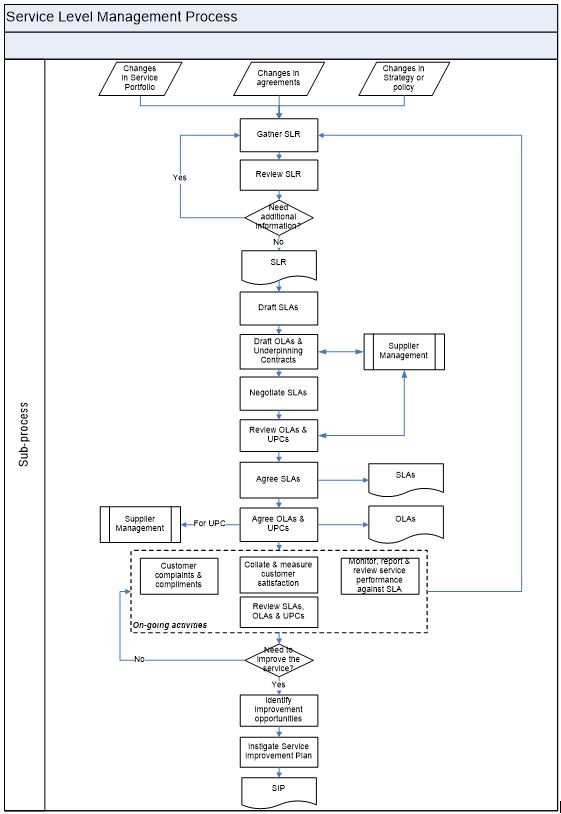
Service Level Management Process flow
Understanding SLAs in Depth
What is an SLA?
A Service Level Agreement (SLA) is a formal contract that defines:
- Expected service performance
- Responsibilities
- Measurement criteria
Types of SLAs
- Customer-based SLA – specific to a customer group
- Service-based SLA – applies to all users of a service
- Multi-level SLA – combines both
Example
- P1 Incident → Resolution within 1 hour
- P2 Incident → Resolution within 4 hours
Beyond SLAs: Introducing XLAs (Experience Level Agreements)
Modern organizations are moving beyond SLAs to Experience Level Agreements (XLAs).
|
SLA |
XLA |
|
Measures system performance |
Measures user experience |
|
Example: 99.9% uptime |
Example: Customer satisfaction |
Why XLAs Matter
- SLA met ≠ Customer happy
- Focus shifts to experience, perception, and outcomes
Detailed explanation of the Service level Management Process flow
| Activity No. | Step | Description | Input/Output | Role |
| 1 | Gather SLR | On a regular basis, the Service Level Manager will capture the Clients requirements. | Input Request from client Alert from SLA Output SLRs | Service Level Manager |
| 2 | Review SLR | The Service Level Manager translates the SLRs of the Client in more detail: Based on the above points, Service Level Manager determines whether IT Service Delivery Organization is capable to deliver the service(s). | Input SLR Output SLR evaluated | Service Level Manager |
| 3 | Need additional information? | If Service level manager needs more information or need to go back to the client with the possible service specification, he will re-look into SLR. | Input Evaluated SLR Output SLR | Service Level Manager |
| 4 | Draft SLAs | Based on the SLRs, the Service Level Manager will document the draft SLA, to be proposed to the client. | Input SLRs Output Draft SLA | Service Level Manager |
| 5 | Draft OLAs & Underpinning Contracts | The respective OLAs and Underpinning Contracts may need to be changed or need to be created afresh in line with the proposed SLA. The Service Level Manager will negotiate the new OLA with the internal teams and the new UPC with the Supplier Management. | Input Agreed SLRs Output OLAs & UPCs | Service Level Manager/Supplier Manager |
| 6 | Negotiate SLAs | Discuss the draft SLA with the client to ensure that all aspects are clearly understood and are in line with the client’s SLRs. | Input Draft SLA Output Amendments on SLA | Service Level Manager |
| 7 | Review OLAs & UPCs | OLAs & UPCs will be reviewed inline with SLAs. | Input Draft OLAs & UPCs Output Amendments | Service Level Manager/Supplier Manager |
| 8 | Agree SLAs | After the review both parties will agree and finalises the SLA. | Input Draft SLA Output Approved SLA | Service Level Manager |
| 9 | Agree OLAs & UPCs | After the SLA is signed off, OLAs & UPCs will be signed off. | Input Draft OLA & UPC Output Approved OLAs & UPCs | Service Level Manager/Supplier Manager |
| 10 | On-going activities | On a regular basis service performance will be monitored, reported & reviewed against SLAs. On a regular basis customer satisfaction will be collected & measured. Customer complaints & compliments will be tracked. SLAs, OLAs & UPCs will be reviewed on a regular basis at least annually (As agreed in the agreement). These ongoing activities can trigger new or modified SLRs. | Input – Service performance – Customer satisfaction – Complaints & Compliments – SLAs, OLAs & UPCs Output – Analysis – Reports – SLRs | Service Level Manager |
| 11 | Need to improve the service? | Based on the analysis & reviews, identify the need for the service improvement. | Input Analysis Reports Output Improvement requirements | Service Level Manager |
| 12 | Identify Improvement opportunities | Based on the analysis improvement opportunities will be identified and will be given as the input to the Service Improvement Plan. | Input Analysis Reports Output Improvement opportunities | Service Level Manager |
| 13 | Instigate Service Improvement Plan | Service improvement plan will be triggered and the actions will be tracked. | Input Improvement Opportunities Output Service Improvement Plan | Service Level Manager |
The Role of CMDB in Service Level Management
A well-maintained Configuration Management Database (CMDB) is essential for SLM.
It enables:
- Accurate service mapping
- Impact analysis in the Incident management process
- Better SLA design based on dependencies
Example
If a payment system depends on:
- Application → Server → Database
A failure in one component impacts the entire service—SLM must reflect this.
SLM Integration with Other ITSM Practices
SLM does not operate in isolation. It integrates with:
Incident Management
- Ensures SLA targets are met during disruptions
Problem Management
- Minimizes service disruption risks
Continual Improvement
- Drives ongoing optimization
Implementing SLM in ServiceNow
Modern platforms like ServiceNow enable advanced SLM capabilities:
- Automated SLA tracking
- Real-time dashboards
- Predictive breach alerts
- Integration with CMDB and workflows
Benefits
- Improved visibility
- Faster decision-making
- Reduced manual effort
Common Challenges in Service Level Management
Organizations often struggle with:
- SLAs not aligned to business outcomes
- Over-customization of ITSM tools
- Poor data quality (CMDB issues)
- Measuring activity instead of value
Key Insight
High SLA compliance does not always mean high service quality
Service Level Management Best Practices for Modern ITSM
To make SLM effective in today’s environment:
- Align SLAs with business outcomes
- Introduce experience-based metrics (XLAs)
- Leverage automation and AI-driven insights
- Ensure accurate CMDB and data governance
- Continuously improve using ITIL 4 continual improvement model
Business Impact of Effective SLM
Organizations adopting modern SLM practices typically achieve:
- 30–50% reduction in MTTR
- Improved customer satisfaction
- Better compliance and audit readiness
- Optimized operational costs
Measurements
Reports are generated based on the below metrics.
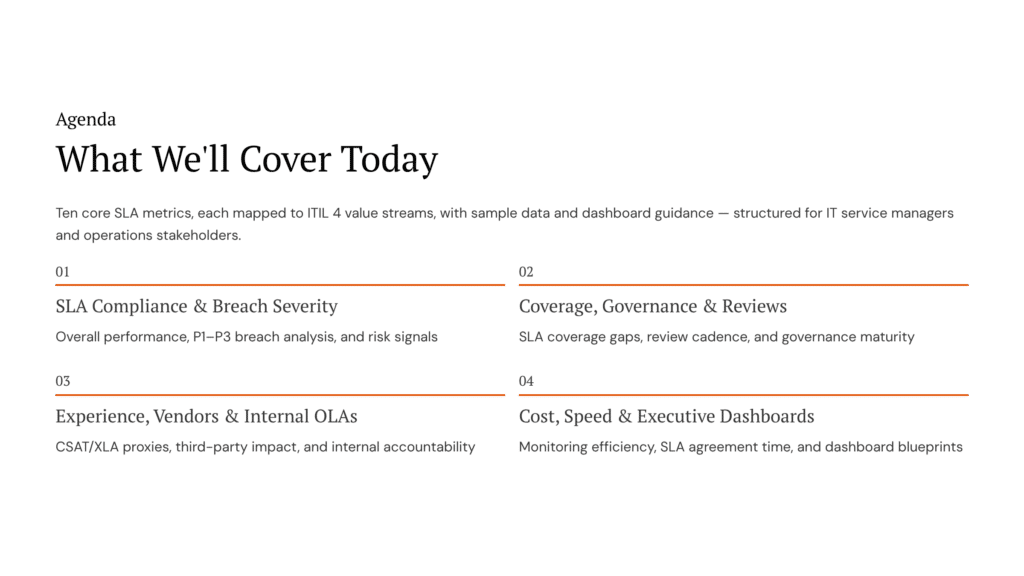
| Metrics | Description |
| % Service targets met | Number or percentage of service targets being met (as Per SLA) |
| Number and severity of service breaches | Number and severity of service breaches |
| Services Vs SLAs | Number of services with up-to-date SLAs |
| Service Vs reports & reviews | Number of services with timely reports and active service reviews. |
| Customer Satisfaction | Improvements in customer satisfaction. |
| SLA breaches due to third-party | Percentage reduction in SLA breaches caused because of third-party support contracts (underpinning contracts) |
| SLA breaches due to internal departments | Percentage reduction in SLA breaches caused because of internal Operational Level Agreements (OLAs). |
| Cost of monitoring & reporting | Percentage reduction in the cost of monitoring and reporting of SLAs |
| Time taken to agree SLA | Percentage increase in the speed and of developing and agreeing appropriate SLAs |
| Service Review meetings | Frequency of service review meetings. |
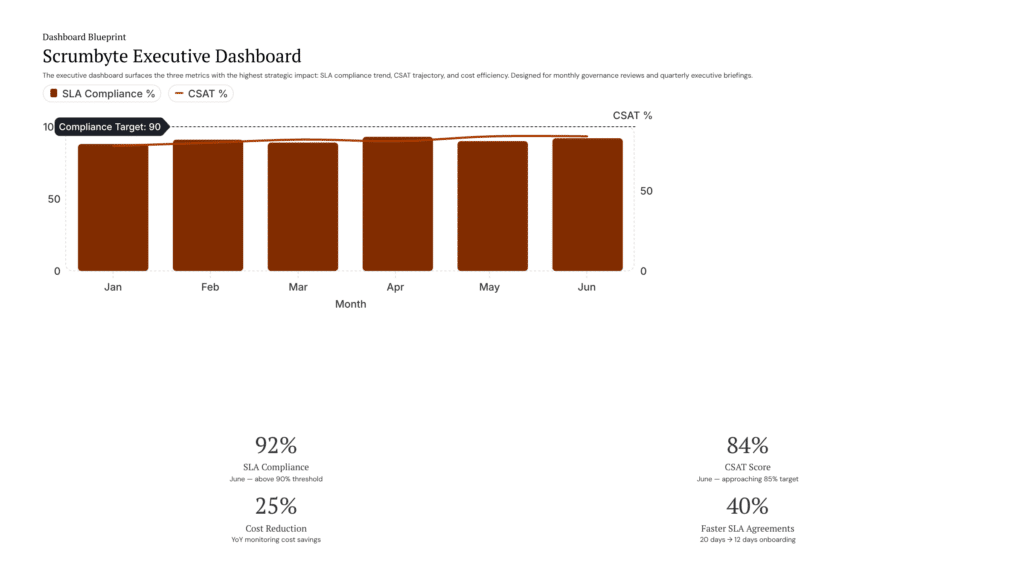
Check the slide show below to understand SLA Metrics Better





Undefined SLAs and Poor Service Visibility Impacting Your Business?
When service levels are not clearly defined, monitored, or aligned with business expectations, it leads to missed SLAs, unclear accountability, and poor user satisfaction. Most organizations struggle because their service level management process is not structured or measurable.
Service Level Management process is meant to define, monitor, and continuously improve service performance—but without the right framework, it becomes reactive instead of strategic .
How Scrumbyte Helps
Struggling to Meet SLAs Consistently?
Frequent SLA breaches, poor visibility into service performance, and unclear accountability are common challenges in Service Level Management. Without a structured approach, SLAs become just numbers—not drivers of service quality.
At Scrumbyte, our ITSM process consulting helps design practical, measurable SLM frameworks aligned with business goals. As an ITSM consulting company, we support SLA design, ITSM gap analysis, and performance improvement—while also enabling tools like ServiceNow for automated SLA tracking and reporting.
If your current setup isn’t delivering results, our ITSM consulting services can help you build a Service Level Management process that actually works.

Vijay Chander is the founder of Scrumbyte, and is a senior IT strategy and service management consultant with over 30 years of global experience across Fortune 100 organizations including Microsoft, Caterpillar, First Data and SWIFT. He has led large-scale enterprise transformations spanning ITSM, architecture, product development, and managed services
Authored by Vijay Chander – All rights Reserved – 2023
Comments are closed