
Introduction
Incident Management framework acts as the central hub and it is the Intelligent Core of IT Operations which drives all service based organizations. While Incident management framework isn’t just about responding to outages—it’s where many frameworks converge. Today in the work of specialization, persons are cocooned into one of the many frameworks and or subject areas.
Many thought leaders having exposure to many areas and aspects of the various frameworks need to get together to build a framework or an engineered architecture bringing the following under an umbrella. Though this is not going to be accepted by all and there will be critical comments, there is a strong feeling that we have to converge to this sometime soon.
- ITIL defines how incidents are recorded, categorized, escalated, resolved, with clear ownership and service levels.
- DevOps brings in continuous monitoring and rapid feedback loops so incidents are detected early.
- Agile at Scale / SAFe / Lean Portfolio Management (LPM) ensure that work requests or incidents feed into prioritization, resource allocation, and portfolio decisions.
- SecOps / NIST / ISO 27001 govern how security-related incidents are handled, ensuring compliance and risk mitigation.
- FinOps monitors the cost and financial impact of downtime and escalations.
- Service Integration (SIAM) or Enterprise Architecture (TOGAF) ensure that multiple service providers, tools, and technologies are aligned.
By integrating all these, Incident Management framework becomes a data hub—alerts feed into security, cost reports, change management; problems feed into root cause analysis, backlog in DevOps or change; priorities align with business value in LPM; architecture ensures consistent asset / CI definitions across tools; compliance frameworks ensure reports and evidence trails.
What Tools Today Enable This Integration
Several tools already approximate this integration: often through modularity or by being platforms with many built-in or integrable components. Here is a list of those tools I was able to look at and many others I am unaware of (will be glad if someone calls them out to me!).
Key Tools & Capabilities for Incident Management framework
| Tool / Category | What It Offers Today | How It Helps Incident Management framework Integration |
| AIOps / Observability tools (Datadog, Dynatrace, New Relic, LogicMonitor, Moogsoft, BigPanda) | These tools can ingest logs, metrics, traces; correlate alerts; reduce noise; detect anomalies; sometimes even suggest root causes. | The system provides multifaceted support: enhancing early detection in DevOps, automatically feeding incident data, cutting down on manual ITIL false positives, and giving FinOps clear cost visibility while providing SecOps with security event insights. |
| ITSM / ITOM Platforms (ServiceNow, ManageEngine, etc.) | Incident workflows, change linkage, knowledge bases, sometimes built-in or integrable discovery / infrastructure mapping, sometimes asset / CI tracking. | These capabilities streamline IT Service Management by automatically converting incidents into change records, connecting them to problem management. Furthermore, they ensure accountability through audit trails for compliance, SLA enforcement, and clear management of roles. |
| SIEM / Security Tools integrated with ITSM | Tools like Qualys, Splunk ES, IBM QRadar, which generate security alerts and often have integrations to trigger incidents in an ITSM ticketing tool. | This system provides the necessary governance framework to manage compliance, mandating that any incident with a security impact is processed with explicit authorization, comprehensive evidence collection, and strict adherence to established protocols (following ISO/NIST guidelines). |
| Linkage via IT4IT / ServiceNow / Enterprise Architecture Tools | Tools that allow defining ITSM value streams, mapping asset / CI / configuration item definitions, data models, dashboards across the stack. | The system actively works to resolve framework misalignment and establishes a consistent taxonomy, ensuring a clear and continuous audit trail that provides traceability from the initial incident all the way through to related changes, problems, and their ultimate impact on the business portfolio. |
Practical Difficulties in Achieving Cohesive Integration
Even though tools are powerful, many organizations struggle implementing an Incident Management framework due to:
- Tool Sprawl & Data Silos
Multiple monitoring, logging, DevOps, ITSM, security tools all producing data in different formats; incidents may be duplicated or mis-categorized because asset definitions or ownership aren’t consistent. - Lack of Unified Taxonomy / Asset/CI Definition
When DevOps, security, ITSM, architecture don’t use the same model of what constitutes “a service / CI / asset / component,” correlation is difficult. - Divergent Processes & Cadences
Agile/DevOps move fast; ITIL processes often have governance, review steps; security / compliance require documentation and evidence. Getting these aligned (without slowing everyone down or compromising compliance) is hard. - People / Ownership / Culture
Who owns an incident? DevOps or IT ops, or SecOps or risk or architecture? Without clear roles, handovers fail. Culture may resist central oversight. - Alert Fatigue and Noise
Many tools generate many alerts; unless noise is reduced or correlated, teams waste time on false positives or miss real problems. - Cost & ROI Justification
Investment in integrations, data modelling, tool licensing, AI modules have costs; demonstrating benefits to executives can be challenging.
A practical outlook with ServiceNow (Can be any other tool)
While a robust Incident Management framework ensures faster resolution and improved service stability, its true effectiveness depends on how well it is embedded within a broader ITSM platform. A structured ServiceNow ITSM implementation roadmap enables organizations to operationalize incident processes through standardized workflows, SLA governance, and intelligent automation. By aligning Incident Management with such a roadmap, organizations can move beyond reactive firefighting to proactive, data-driven service management that delivers consistent and measurable outcomes.
What AI & Future Tools Can Do / We Should Expect for a proper Incident Management Framework
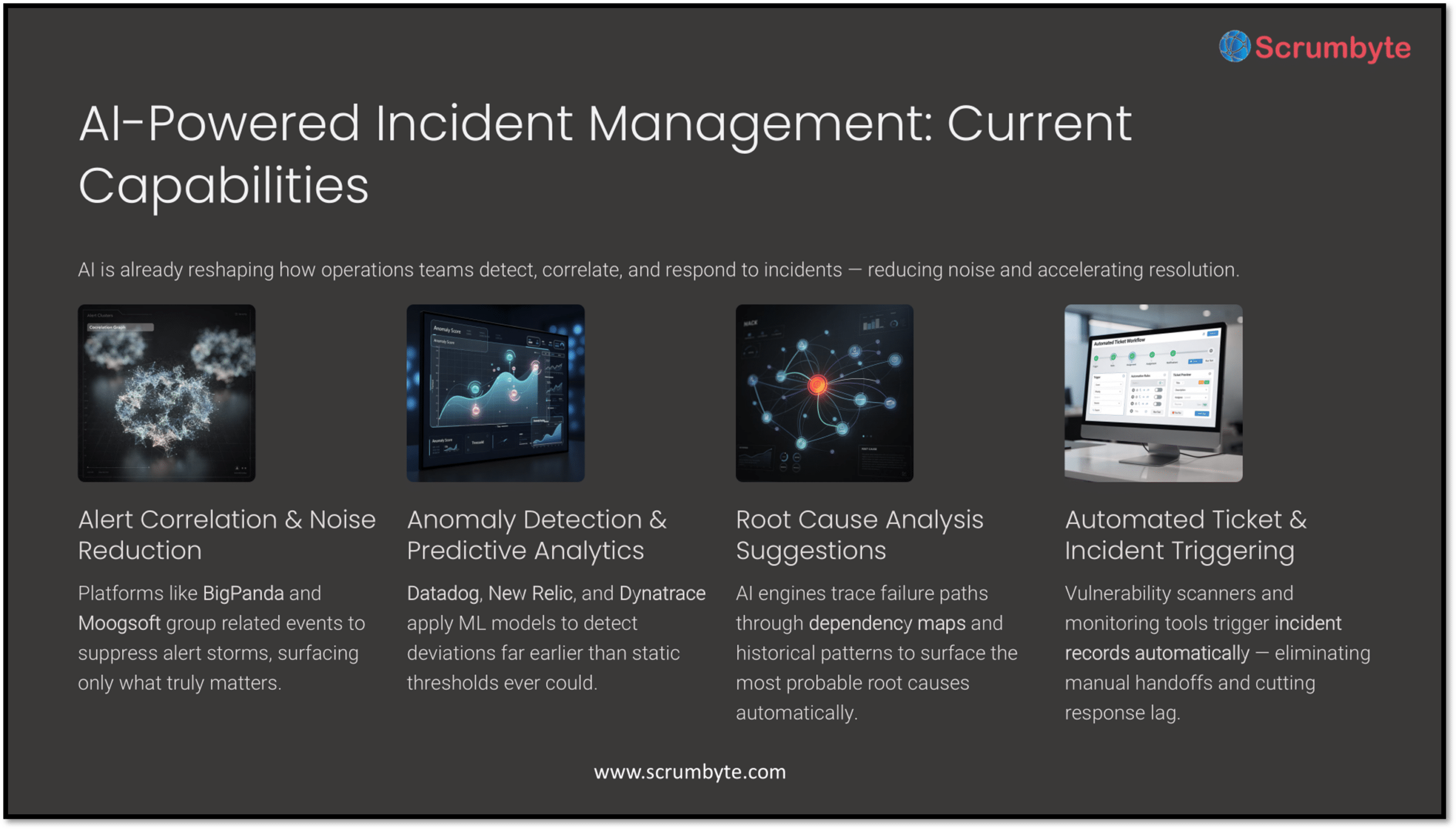
AI is emerging as a catalyst to resolve many of the above difficulties. Some capabilities are already available; more are coming.
Current Capabilities
- Alert Correlation & Noise Reduction: Tools like BigPanda, Moogsoft reduce alert storms by grouping related events.
- Anomaly Detection & Predictive Analytics: Datadog, New Relic, Dynatrace provide ML-based detection vs static thresholds.
- Root Cause Analysis Suggestions: Some platforms can suggest likely causes via dependency maps or historical patterns.
- Automated Ticket Creation / Incident Triggering: From security scans or monitoring events (e.g. vulnerability scanner triggers incident automatically).
What’s Emerging / Should Be Expected
- LLM-based Unified Knowledge Graphs
AI agents that maintain a live, query able knowledge graph connecting incidents → CIs → changes → security risks → financial impact. Therefore, you might ask: “Which change request from last month is most likely to cause cost spikes across services?” and get informed answers. - AgentOps / Autonomous Incident Handling
Agents that can not only detect, but automatically triage, escalate, even remediate known incidents (e.g., infrastructure auto-recovery). The AIOPSLAB research shows frameworks to evaluate AI agent automation for full incident lifecycle. - Process Mining + Suggestion Engines
Tools that observe how incidents flow through teams, map bottlenecks, suggest where steps can be removed, or where automation or SLAs could be better. - Cross-Framework Orchestration Platforms
Platforms that enable orchestrated policies across DevOps, ITSM, SecOps, FinOps etc., so policy changes (e.g., compliance requirements) automatically reflect in incident process, change process, monitoring thresholds, cost dashboards, etc. - Self-Learning / Self-Healing Systems
Combining observability, AI, infrastructure automation so that certain incident types are auto resolved without human intervention (e.g., scaling, restarting services, re-routing traffic) after validation.
Saying and doing are very different and difficult. Here below is an example of how a flow could look like
Example: What A Fully Integrated Incident Management Flow Could Look Like

Summary
Incident Management framework is not isolated, it is the Intelligent core of IT Operations, it’s where process, people, tech, value, and governance intersect. To make this intersection work well:
- Use an architectural blueprint like IT4IT to define how frameworks, toolchains, data, and responsibilities should align.
- Leverage today’s AIOps / ITSM / monitoring / observability tools to build real-time detection, correlation, incident auto-creation, cross-functional visibility.
- Invest in AI-forward capabilities: knowledge graphs, LLMs, agent-based remediation, process mining.
With these, Incident Management becomes the Intelligent core of IT Operations and less about firefighting and more about orchestrating stability, compliance, efficiency, and innovation — delivering value not just by restoring service, but by shaping how the organization learns, adapts, and invests.
Still Stuck in Incident Firefighting Mode?
Frequent outages, missed SLAs, and slow resolutions are signs your incident management lacks a structured framework. Without it, teams stay reactive, tools like ServiceNow remain underutilized, and problems keep repeating.
Build a Scalable Incident Management Framework.
At Scrumbyte, we help you move from chaos to control with:
- Incident management framework consulting aligned with ITIL
- ITSM process consulting services to standardize and streamline workflows
- ITSM process optimization to reduce MTTR and eliminate bottlenecks
- ServiceNow ITSM implementation services for automation and visibility
- ITSM maturity assessment & gap analysis for a clear improvement roadmap
Take Control of Your Incidents
Stop reacting – start preventing.
With the right ITSM consulting services, you can reduce incident volume, improve SLA performance, and gain full operational control.
Talk to our experts today to transform your incident management.

Vijay Chander is the founder of Scrumbyte, and is a senior IT strategy and service management consultant with over 30 years of global experience across Fortune 100 organizations including Microsoft, Caterpillar, First Data and SWIFT. He has led large-scale enterprise transformations spanning ITSM, architecture, product development, and managed services
All rights reserved – Scrumbyte 2025 – Authored by Vijay Chander
Comments are closed