
Preface
For many years, Global Capability Centers (GCCs) were viewed as the domain of Fortune 500 companies. Organizations such as Microsoft, Oracle, JPMorgan Chase, HSBC, and SAP built large engineering and operations centers in India employing thousands of professionals. Today, however, the economics have changed. Advances in cloud infrastructure, remote collaboration, and India’s mature technology ecosystem have made it entirely feasible for small and medium-sized businesses to establish their own GCC with 10–25 employees and scale gradually as business grows.
Having been involved in establishing and scaling technology operations in India, I have seen first-hand that success is rarely determined by office space or salaries alone. It depends on understanding the regulatory environment, building the right operating model, and creating a sustainable organization that integrates seamlessly with the parent company.
Why India Continues to be the Preferred GCC Destination
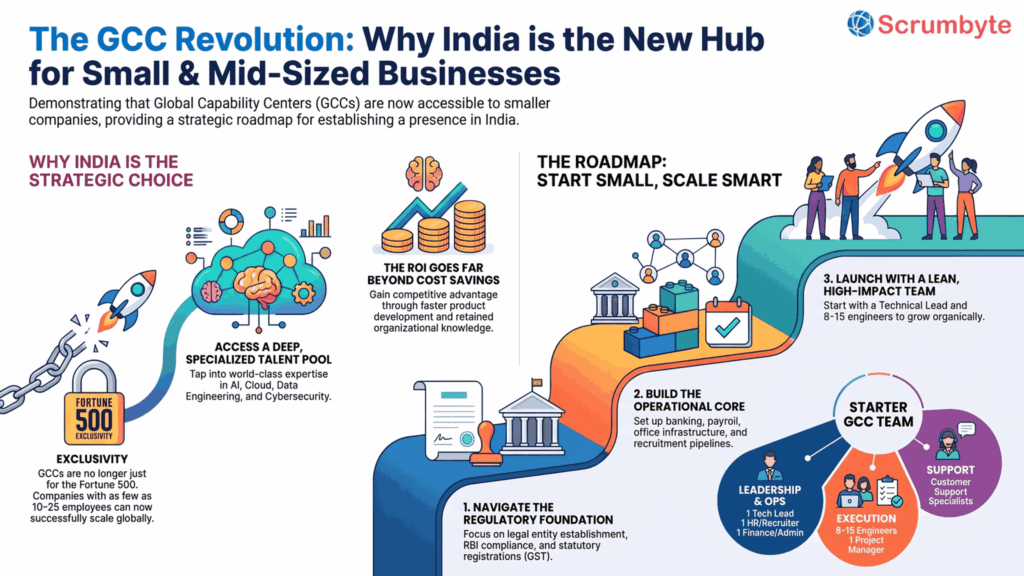
India has evolved far beyond being a low-cost outsourcing destination. It has become a global innovation hub with one of the world’s largest pools of technology professionals.
Companies gain access to professionals experienced in:
- Software Engineering
- Cloud Technologies
- Artificial Intelligence and Machine Learning
- Data Engineering
- ERP platforms such as Oracle and SAP
- Cybersecurity
- DevOps
- IT Service Management (ITIL)
- Product Engineering
- Digital Transformation
- Shared Services and Business Operations
For smaller organizations, this means hiring talent comparable to global standards while maintaining significantly lower operating costs.
Why Start Small?
Many organizations assume they need to establish a 100-person operation before opening an office in India. In reality, a 10–25 person GCC often provides a better balance between investment and operational control.
A typical initial team might include:
- Country Manager
- HR & Talent Acquisition
- Finance & Administration
- Technical Lead
- Software Engineers
- QA Engineers
- Cloud Engineers
- Support Engineers
- Business Analyst
- Project Coordinator
Such a structure allows companies to validate their delivery model before committing to large-scale expansion.
Choosing the Right Legal Structure
The first major decision is selecting the legal entity.
Most foreign companies typically establish one of the following:
- Wholly Owned Subsidiary
- Private Limited Company
- Branch Office
- Liaison Office
- Limited Liability Partnership (in specific situations)
For organizations intending to hire employees and generate revenue in India, a Wholly Owned Subsidiary is generally the preferred structure because it provides operational flexibility while maintaining complete ownership by the parent company.
Navigating Government Requirements
Many overseas organizations perceive India’s regulatory system as complicated. In practice, the process is straightforward when approached systematically.
The major activities include:
Corporate Registration
- Company incorporation
- Director Identification Numbers
- Digital Signatures
- Permanent Account Number (PAN)
- Tax Deduction Account Number (TAN)
Banking
- Opening Indian bank accounts
- RBI compliance for foreign investment
- Foreign inward remittance documentation
- Ongoing foreign exchange reporting
Tax Registration
- GST Registration
- Professional Tax (state-specific)
- Shops and Establishments registration
- Labour registrations where applicable
Statutory Compliance
- Employee Provident Fund (EPF)
- Employee State Insurance (ESI) where applicable
- Payroll compliance
- Income Tax deductions
- Annual ROC filings
- Statutaneous audits
Working with experienced legal advisors, Chartered Accountants, Company Secretaries, and payroll specialists significantly reduces complexity.
Understanding Foreign Exchange
One area that often concerns overseas companies is moving money into and out of India.
Fortunately, India has a well-defined framework governed by FEMA (Foreign Exchange Management Act).
Typical activities include:
- Capital investment from parent company
- Monthly operational funding
- Salary payments
- Vendor payments
- Profit repatriation
- Dividend declarations
- Transfer pricing compliance
Proper documentation ensures smooth inward funding and future repatriation of profits.
The Cost Advantage
For many organizations, the financial benefits are substantial.
Consider a small engineering team of twenty professionals.
Typical annual operating costs in India may include:
- Salaries
- Office infrastructure
- Recruitment
- IT hardware
- Cloud infrastructure
- Payroll processing
- Finance & Compliance
- HR Operations
- Insurance
- Internet and Connectivity
- Legal and Audit
Even after accounting for these expenses, the overall operating cost can often be 40–60% lower than maintaining a similar team in North America or Western Europe, depending on the roles and locations.
However, the greatest return is not simply lower cost—it is the ability to reinvest savings into product development, customer success, or business expansion.
Talent Availability
Cities such as:
- Hyderabad
- Bengaluru
- Chennai
- Pune
- NCR
- Coimbatore
- Kochi
offer deep talent pools across enterprise technologies and digital engineering.
Hyderabad, in particular, has become attractive due to its strong infrastructure, international airport connectivity, competitive operating costs, and presence of global technology companies.
Building the Right Culture
A GCC should never function as an offshore vendor.
Instead, employees should become an extension of the parent organization.
Successful companies invest in:
- Common communication standards
- Shared engineering practices
- Unified project management
- Leadership development
- Continuous technical training
- Career progression
- Cross-country collaboration
Employees who feel connected to the organization’s mission generally remain longer and contribute more effectively.
Common Mistakes to Avoid
Several recurring challenges can delay or undermine a GCC initiative:
- Underestimating statutory compliance requirements
- Hiring too quickly without defined processes
- Choosing office space before defining workforce needs
- Neglecting local HR policies
- Weak onboarding and training
- Poor communication between headquarters and India
- Viewing the GCC solely as a cost-saving exercise
Organizations that focus only on reducing expenses often miss the opportunity to build genuine innovation capabilities.
A Phased Growth Strategy
Rather than making a large upfront investment, many companies adopt a phased approach.
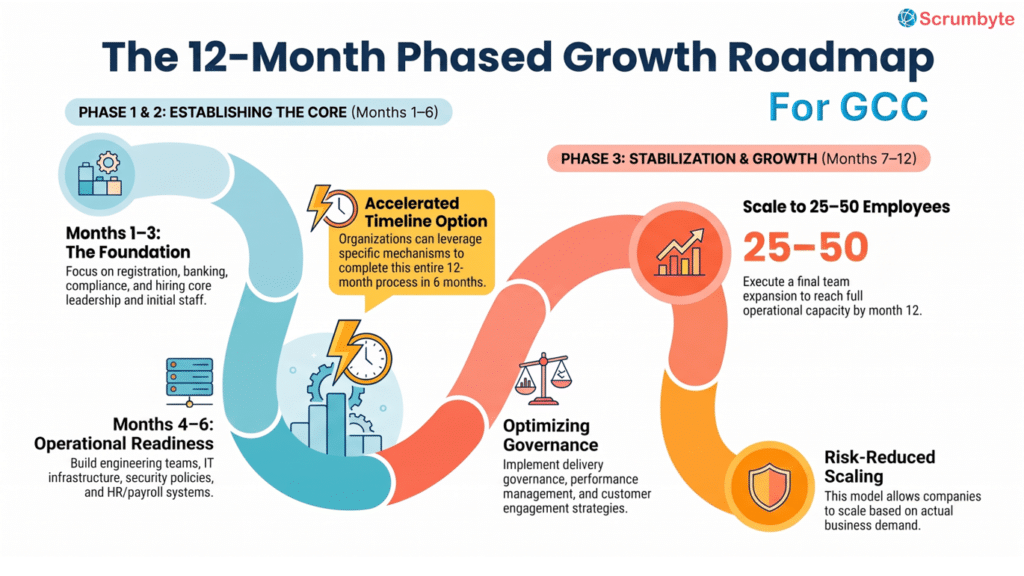
Phase 1 – Foundation (Months 1–3)
- Company registration
- Banking
- Compliance
- Leadership hiring
- Office setup
- Initial recruitment
Phase 2 – Operational Readiness (Months 4–6)
- Engineering teams
- HR processes
- Payroll
- IT infrastructure
- Security policies
Phase 3 – Stabilization (Months 7–12)
- Delivery governance
- Performance management
- Customer engagement
- Process optimization
- Team expansion to 25–50 employees
This phased model reduces operational risk while allowing organizations to scale based on actual business demand. However, there exist mechanisms to move this timeline significantly and complete the entire process in 6 months or less depending on the urgency and willingness to move fast.
Beyond Cost Savings
The true value of a GCC extends beyond labor arbitrage.
A well-managed India center can provide:
- 24×7 customer support
- Faster product releases
- Dedicated engineering capacity
- Business continuity
- Access to niche technical skills
- Global delivery capability
- Increased innovation
- Long-term organizational resilience
Many organizations discover that their India teams eventually become centers of excellence responsible for product development, architecture, AI initiatives, cloud engineering, and digital transformation.
Final Thoughts
Establishing a Global Capability Center in India is no longer reserved for multinational corporations with thousands of employees. Today, even organizations with modest budgets can build high-performing teams of 10–25 professionals that operate as strategic extensions of their global business.
The key lies in planning carefully, understanding regulatory requirements, investing in the right people, and viewing the GCC as a long-term capability rather than simply a cost-saving initiative. With the right foundation, a small GCC can evolve into a core driver of innovation, customer success, and sustainable growth.
For companies in the United States, Europe, MENA, and Southeast Asia, India offers a unique combination of skilled talent, mature infrastructure, and a well-established regulatory framework. Starting small allows businesses to minimize risk while creating a scalable platform for future expansion—one that can grow alongside the organization and become an integral part of its global strategy.
Scrumbyte can help you setup a GCC center, even with a minimum of 5 persons and help you gradually scale up. Contact us for more details or call us directly.

Vijay Chander is the founder of Scrumbyte, and is a senior IT strategy and service management consultant with over 30 years of global experience across Fortune 100 organizations including Microsoft, Caterpillar, First Data and SWIFT. He has led large-scale enterprise transformations spanning ITSM, architecture, product development, and managed services

Comments are closed