
Introduction
The future of SLAs in ITSM is crucial in today’s digital driven business world, where consistent and high-quality IT services are essential for competitiveness. Central to this is the Service Level Agreement (SLA), which outlines expectations between service providers and customers regarding service quality, performance, and response times.
However, as IT environments become more complex, traditional SLAs are inadequate. The integration of Artificial Intelligence (AI) is transforming SLA management by allowing for better predictions, automation, and proactive decisions.
In this blog, we explore how SLAs are evolving in the AI era, what tools support this transformation, key related terms, and what the roadmap for SLA management looks like over the next five years. You can also visit my earlier blog on SLA Management.
Understanding SLAs in ITSM
A Service Level Agreement outlines the agreed-upon parameters of service delivery between an IT service provider and a customer. These parameters typically include:
- Uptime guarantees (e.g., 99.9% service availability)
- Incident response and resolution times
- Support hours and channels
- Performance metrics and KPIs
- Penalties for non-compliance
SLAs not only set clear expectations but also serve as a reference point for continuous service improvement.
Key Related Terms and Their Meanings
To fully grasp SLAs in an ITSM context, it’s essential to understand the ecosystem of associated terms:
- Operational Level Agreement (OLA): An internal agreement that supports SLA delivery, ensuring different internal support groups meet specific performance standards.
- Underpinning Contract (UC): Contracts with external vendors that support SLA commitments. Failure in a UC may impact SLA delivery.
- Key Performance Indicator (KPI): Quantifiable metrics that assess SLA compliance (e.g., average resolution time, ticket volume).
- Service Level Management (SLM): The overarching process that ensures SLAs, OLAs, and UCs are defined, monitored, and improved.
- Quality of Service (QoS): The overall service quality perceived by the user, often derived from adherence to SLAs and KPIs.
- Service Level Commitment (SLC): A more informal or non-contractual agreement between a provider and user about service expectations.
- Service Level Objective (SLO): Specific measurable characteristics of the SLA, like availability or response time.
- Service Level Indicator (SLI): Actual metrics used to evaluate performance (e.g., 99.5% uptime over 30 days).
Challenges in Traditional SLA Management
Despite their importance, traditional SLA management presents several challenges:
- Static and Rigid: SLAs are often hardcoded and do not adapt to changing service conditions or business priorities.
- Lack of Real-time Monitoring: Manual tracking makes it difficult to detect SLA breaches in real-time.
- Inefficient Reporting: Extracting insights from historical SLA data is cumbersome.
- Reactive Response: Teams often discover SLA breaches after they occur, leading to escalations and customer dissatisfaction.
How AI is Transforming SLA Management
AI introduces dynamic, intelligent, and self-optimizing capabilities into SLA management. Here are some key ways AI is reshaping SLA handling:
1. Predictive SLA Breach Detection
AI models can analyze incident history, ticket trends, and resource availability to predict SLA breaches before they occur. This allows teams to intervene proactively and avoid escalations.
2. Automated Prioritization and Routing
AI can classify and route incidents based on urgency, customer profile, and historical resolution data. This improves response times and ensures critical issues get immediate attention.
3. Dynamic SLA Adjustments
Machine learning algorithms can suggest SLA modifications based on usage patterns, time-of-day traffic, or seasonality. For instance, response times can be adjusted during peak hours without compromising overall service quality.
4. Conversational AI and Virtual Agents
AI-powered chatbots can handle L1 support, update users on SLA status, and even escalate to human agents when necessary, reducing workload and improving communication.
5. Real-time Analytics and Visualization
AI-enhanced dashboards provide real-time SLA metrics and flag anomalies, enabling service managers to take informed actions swiftly.
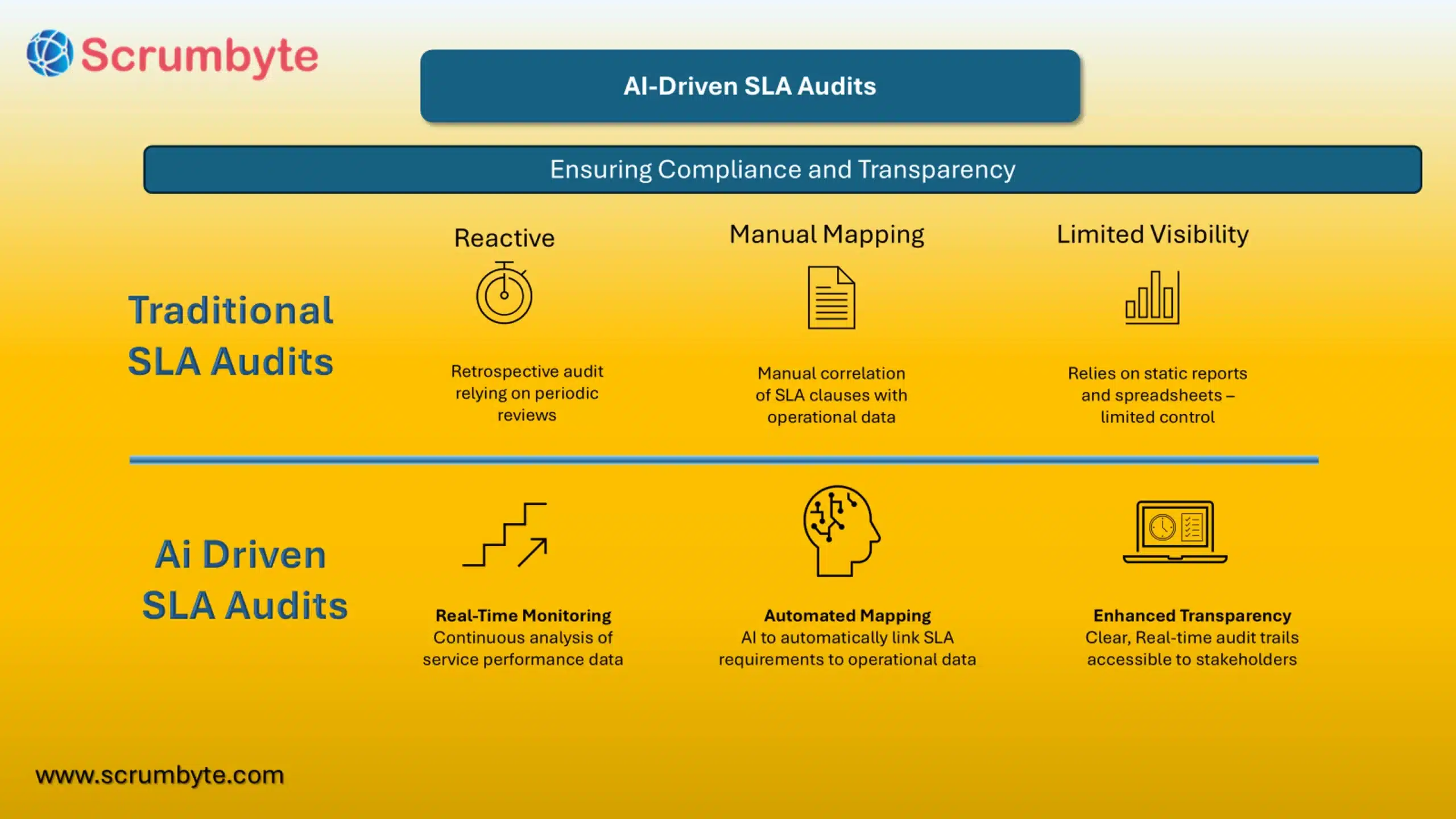
6. SLA Audits
AI in SLA audits enables real-time compliance monitoring and intelligent insights, ensuring transparency, accuracy, and faster identification of potential service breaches. The diagram below gives a comparision.
Top Tools Supporting AI-Driven SLA Management
Below is a comparison table of popular ITSM platforms that integrate AI into SLA functionalities:
| Tool/Platform | AI Features | SLA Capabilities | Strengths | Pricing Tier |
| ServiceNow ITSM | Predictive Intelligence, Virtual Agent | Dynamic SLA policies, auto-escalation | Enterprise-grade, extensive integration | Premium |
| BMC Helix ITSM | AI/ML for anomaly detection, Chatbots | SLA monitoring, custom thresholds | Hybrid cloud support, rich analytics | Premium |
| Freshservice | Freddy AI Assistant, automation rules | SLA policies, automated workflows | User-friendly, fast deployment | Mid-range |
| Ivanti Neurons | Self-healing automation, AI bots | Custom SLAs, incident prioritization | Scalable AI-driven IT automation | Mid to High |
| Jira Service Management | ML-based automation, Conversational AI | SLA configuration per issue type | Developer-centric, flexible API integrations | Affordable to Premium |
| ManageEngine ServiceDesk Plus | Zia AI Assistant, analytics | Multi-level SLAs, automated breach alerts | Cost-effective, easy setup | Affordable |
Use Case: AI-Driven SLA Optimization in Action
Scenario: A mid-sized IT support team is experiencing frequent SLA breaches due to high ticket volumes and limited staff.
Solution:
- An AI-based system predicts which tickets are at risk of breaching SLAs based on patterns and resolution history.
- Virtual agents handle repetitive queries, freeing human agents for complex issues.
- AI adjusts SLA thresholds during off-peak hours and reassigns tasks based on agent availability.
- Real-time dashboards alert managers of impending issues, enabling proactive resolution.
Outcome: SLA compliance improves by 30%, customer satisfaction increases, and support efficiency is enhanced.
Building an AI-Enabled SLA Strategy: Roadmap
To harness AI in SLA management effectively, organizations can follow a phased roadmap:
Phase 1: Baseline Readiness (0-6 Months)
- Audit current SLA structure, tools, and incident patterns.
- Identify pain points and set measurable SLA goals.
- Start integrating basic AI features (e.g., chatbots or ticket classification).
Phase 2: Automation and Intelligence (6-18 Months)
- Deploy AI models to predict SLA breaches.
- Automate ticket routing and escalation workflows.
- Establish real-time monitoring with AI dashboards.
Phase 3: Self-Optimization (18-36 Months)
- Use AI to suggest SLA adjustments dynamically.
- Introduce AI-based load balancing and scheduling.
- Develop feedback loops for continuous SLA improvement.
Phase 4: AI-First SLA Management (3-5 Years)
- Fully autonomous SLA policy updates driven by business outcomes.
- Integration with business intelligence tools.
- Natural Language Processing (NLP) to understand SLA narratives from tickets.
The Future of SLAs in ITSM
The next five years will see SLA management evolve from a reactive, contract-bound function to a dynamic, AI-powered strategy that aligns closely with business goals. Expect to see:
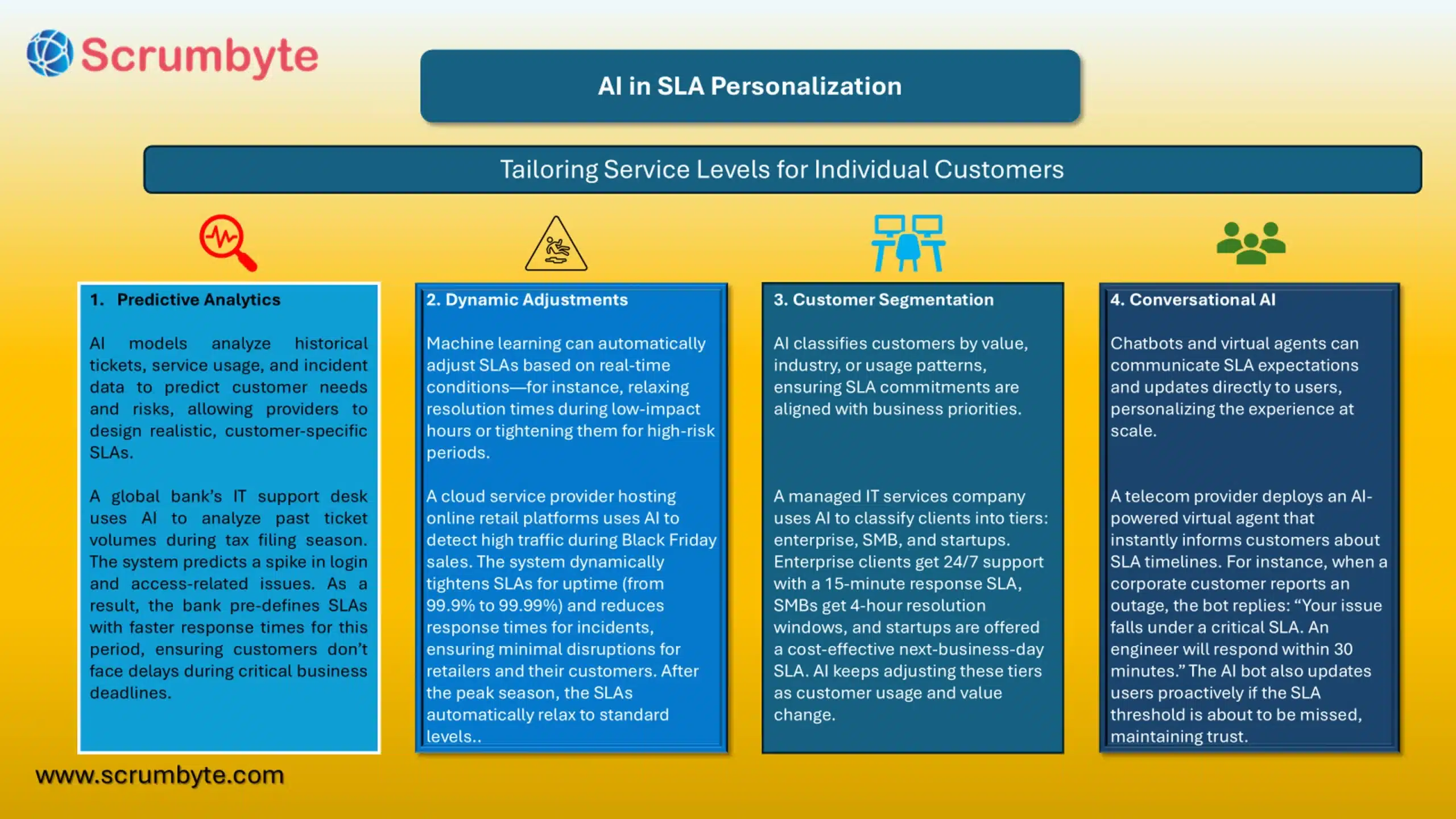
- SLA Personalization: Individualized SLAs per user or department based on data usage and risk. The diagram below gives a more detailed representation and is good for another blog!
- AI Governance: Transparent AI models for SLA predictions and decisions.
- Hyperautomation: End-to-end automated SLA lifecycle from definition to retirement.
- Blockchain Integration: Immutable SLA contracts ensuring trust and transparency.
In summary
SLA s are entering a transformative era powered by AI. SMEs and large enterprises alike must recognize the strategic importance of upgrading their SLA frameworks to be intelligent, adaptive, and customer-focused. By embracing AI, organizations can unlock efficiencies, improve compliance, and drive exceptional service delivery. Whether you’re starting from scratch or enhancing an existing ITSM framework, the roadmap ahead is clear: intelligent automation is not just the future of SLA management—it’s already here.

Vijay Chander is the founder of Scrumbyte, and is a senior IT strategy and service management consultant with over 30 years of global experience across Fortune 100 organizations including Microsoft, Caterpillar, First Data and SWIFT. He has led large-scale enterprise transformations spanning ITSM, architecture, product development, and managed services, with deep expertise in ITIL, CMMI, PMO, and AI-driven automation in the USA, Europe and India – experienced in Finance, Manufacturing and Supply chain logistics. Through Scrumbyte, Vijay helps organizations translate complex IT challenges into practical, outcome-driven strategies.
Comments are closed