
Introduction
As the world has moved on to a digital-first workplace, the ability to deliver services quickly, consistently, and efficiently is no longer optional, Service Request Management is the window to a wonderful user experience. Amongst all service management practices, Service Request Management (SRM) is the one that most users interact with daily. Whether it’s requesting access to applications, ordering a laptop, seeking information, or resetting a password, Service Request Management represents the front door to IT services.
With ITIL 4 framework, Service Request Management has evolved into a more integrated, value-driven, user-centric practice. We will take a deep dive into how organizations can design and operate SRM effectively using ITIL 4 concepts, value streams, and modern digital workflows.
Understanding Service Request Management in ITIL 4
ITIL 4 defines Service Request Management as:
“The practice of supporting agreed service quality by handling all predefined, user-initiated service requests in an effective and user-friendly manner.”
Let’s break this down:
- Predefined: These are not incidents, not problems, and not changes. They follow documented, repeatable workflows.
- User-Initiated: They originate from employees, partners, or customers as part of normal operations.
- Service Quality Support: Service Request Management’s objective is not just fulfillment, but maintaining consistent service levels.
What makes Service Request Management especially important in ITIL 4 is its alignment with the service value system (SVS) and the emphasis on value streams rather than isolated processes. In ITIL 4, SRM is not a standalone function – it interacts closely with practices such as Access Management, Knowledge Management, Change Enablement, and Incident Management.

Why SRM Matters More Than Ever
IT Users have become more demanding, requiring:
- Instant responses
- Clear communication
- Fast delivery
- Self-service options
- Mobile accessibility
This is the outcome of the fast digital delivery world today.
So, the expectation of a well-designed Service Request Management practice should directly improve:
✔ Productivity
Quick request fulfillment reduces downtime and accelerates onboarding, collaboration, and workflow execution.
✔ User Satisfaction
Transparent status updates, predictable timelines, and intuitive service catalogs enhance trust in IT.
✔ Operational Efficiency
Standardizing requests reduces manual workload, rework, and dependency on senior technical staff.
✔ Governance
Defined request models enforce compliance, data accuracy, and approval policies.
✔ Automation Readiness
When requests follow clear patterns, they are easier to automate and shift left.
Service Request Management is often the first practice that organizations modernize because it delivers quick, measurable wins.
Key Components of Service Request Management in ITIL 4
A. Service Request Models
These are predefined workflows for common requests.
A model includes:
- Required information
- Steps and activities
- Roles and responsibilities
- Approvals
- Expected completion time
- Automation triggers
- Escalation paths
Examples include:
- New employee onboarding
- Password reset
- Access to Salesforce/HR system
- Laptop replacement
- Distribution list creation
B. Service Catalog
This is the heart of Service Request Management.
A Service Catalog is a structured and user-friendly listing of all the services an IT organization offers, along with the information users need to request them. Consider it as a good restaurant menu, which describes the dish in detail, with ingredients, cooking method and time to deliver on your table. It acts as the single source of truth for available services, detailing what each service includes, who can access it, how to request it, and the expected delivery timelines. By providing transparency, consistency, and self-service experience, the service catalog enhances user satisfaction while helping IT teams streamline workflows, reduce ticket errors, and operate more efficiently. In modern ITSM, the service catalog is not just a menu – it’s the foundation for standardized, predictable, and scalable service delivery.
To understand further, a catalog provides:
- Request descriptions
- Eligibility rules
- SLAs
- Fulfillment steps
- Costs (if applicable)
- Self-service submission pathways
A mature service catalog reduces tickets by enabling users to help themselves.
C. Knowledge Articles
ITIL 4 promotes knowledge as a strategic asset.
Knowledge Management process is one of the strongest enablers of high-performing Service Request Management. Well-structured knowledge articles help users submit accurate requests, reduce back-and-forth clarifications, and empower self-service by guiding them through common tasks without needing IT assistance. For service desk teams, knowledge articles ensure consistent fulfillment, faster resolution, and fewer errors – especially for routine or high-volume requests. By capturing best practices, troubleshooting steps, and requesting instructions in a reliable knowledge base, organizations create a streamlined, scalable Service Request Management practice where both users and support teams benefit from clarity, speed, and repeatable success. To see how a focused, short-duration engagement can rapidly assess your ITSM maturity and deliver measurable improvement opportunities, explore our ITSM Maturity & Gap Analysis offering.
Knowledge articles support:
- Request submission guidance
- Troubleshooting
- FAQs
- User training (Videos and articles)
Knowledge integration also boosts automation and AI-driven responses.
D. Automation & Self-Service
Automation and self-service are transforming Service Request Management from a manual, ticket-driven workflow into a fast, user-empowered experience. By automating repetitive fulfillment tasks – such as access provisioning, password resets, or software installations – IT teams eliminate delays and reduce operational effort. At the same time, self-service portals and chatbots give users the ability to submit requests, track status, and even resolve common needs without waiting for support. Together, automation and self-service not only improve speed and accuracy but also enhance user satisfaction and free up IT staff to focus on more complex, high-value work. They are essential components of a modern, efficient Service Request Management practice aligned with ITIL 4 principles.
With so much of AI driving automation, current and futuristic Service Request Management relies on:
- Chatbots
- Automated workflows
- IAM (Identity and Access Management) integrations
- Approval orchestration
- Asset management links
Automation is not just a convenience – it transforms Service Request Management from reactive to proactive.
Discover how our Process Redesign engagement helps organizations streamline ITSM workflows, eliminate inefficiencies, and align operations with business outcomes.
Service Request vs. Incident: Understanding the Difference
One of the biggest challenges in ITSM is distinguishing between incidents and service requests. There is a big difference though and your front line staff viz, service desk operators, need to know how to make a distinction between them.
Incident
Something is broken and needs fixing.
Examples: Wi-Fi not working, system outage.
Service Request
A predefined service being requested.
Examples: New laptop, software installation.
Why this matters:
- Incidents require restoration of service
- Requests follow fulfillment workflows
- Mixing the two causes delays and reporting inaccuracies
ITIL 4 encourages creating clear intake channels and triage workflows to route each appropriately.
Designing a Service Request Value Stream (ITIL 4 Approach)
ITIL 4 emphasizes value streams—end-to-end flows representing how value is created.
Let’s look at a typical Service Request Value Stream using the example of an access request.
Step 1: Trigger
User submits request through a portal, chatbot, or email.
Step 2: Logging & Categorization
System auto-categorizes based on request type.
Step 3: Validation
Does the request follow policy?
Is required information complete?
Step 4: Approval (If needed)
Role-based provisioning dramatically reduces approval overhead.
Step 5: Fulfillment
Automated or manual provisioning of access.
Step 6: Communication
User receives confirmation and instructions.
Step 7: Closure & Feedback
Request is closed; user satisfaction captured.
Metrics to Track
- Lead time
- First contact resolution
- Automation rate
- Rework rate
- CSAT
This value stream approach exposes inefficiencies and highlights improvement opportunities.
Best Practices for Effective Service Request Management (ITIL 4)
1. Create Clear and Complete Request Models
Users should not guess what information IT needs.
Request models should specify:
- Mandatory fields
- Policy checks
- Data validation rules
- Workflow steps
- Expected SLA’s
To illustrate the above let us look at the following example
Request Model Example – Laptop Request
A well-defined laptop request model ensures smooth fulfillment, reduces back-and-forth communication, and enables automation where possible.
Mandatory Fields
The requester must provide:
- Employee Name
- Employee ID
- Job Role / Department
- Manager Name & Email
- Laptop Type Needed (Standard / Developer / High-Performance)
- Operating System (Windows / macOS / Linux)
- Preferred Delivery Location (Office / Remote address)
- Required Date
- Business Justification (for non-standard models)
Policy Checks
Before approval or fulfillment, the system verifies:
- Eligibility based on role (e.g., Developers may require higher-spec laptops)
- Budget or cost center availability
- Whether a laptop is already assigned to the employee
- Whether additional approvals are needed for upgraded configurations
- Inventory availability (via ITAM / CMDB)
- Compliance requirements (e.g., security policies, data protection)
Data Validation Rules
To reduce rework and incorrect submissions:
- Manager email must match corporate domain
- Required Date cannot be in the past
- Delivery address mandatory for remote workers
- Laptop Type must be selected from predefined models
- Employee ID must match HRMS records
- Business justification required if user selects “High-Performance” or “Custom”
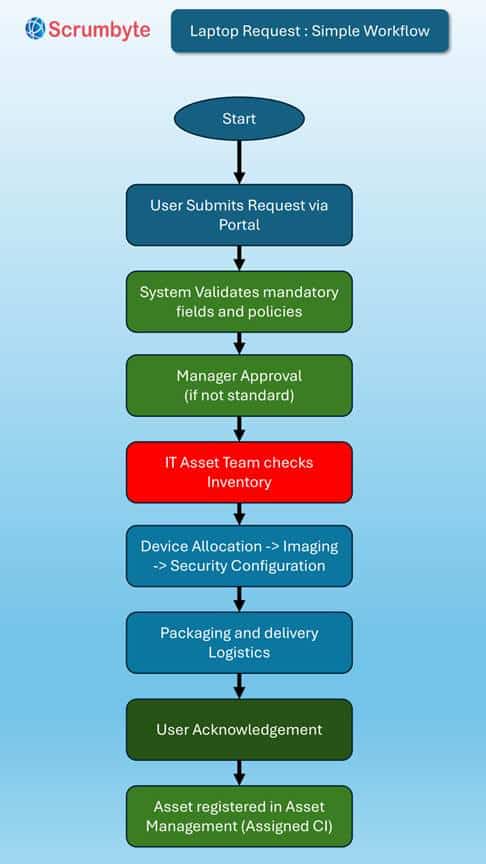
Workflow Steps (Overview)
A complete request model defines the sequence:
- User submits request via portal
- System validates mandatory fields and policies
- Manager approval (only if non-standard)
- IT Asset Team checks inventory
- Device allocated → imaging → security configuration
- Packaging and delivery logistics
- User acknowledgment
- Record updated in Asset Management (assigned CI)
- Request closed and feedback collected
Expected SLAs
- Standard laptop: 2 business days
- Developer/high-performance laptop: 3–5 business days
- Remote delivery: +2 days for logistics
Why this model works
- Reduces back-and-forth clarifications
- Ensures IT has all required information from the start
- Supports automation (auto-approval for standard laptops)
- Ensures compliance and accurate asset tracking
- Improves user experience with predictable timelines
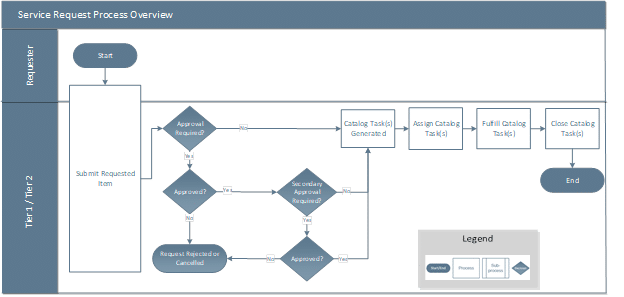
Another way of looking at the above in as a generic workflow is shown below
2. Standardize and Automate Approvals
ITIL 4 strongly encourages:
- Preapproved bundles
- Segmentation by risk level
- Reduction of unnecessary approvers
3. Shift Left with Self-Service
Give users:
- Knowledge articles
- Chatbot assistance
- Guided workflows
- Auto-resolve options
Self-service adoption is the single biggest cost reducer in SRM.
4. Integrate SRM with Key IT Practices
SRM works best when connected to:
- IAM → automated provisioning
- CMDB/ITAM → asset tracking
- Change Enablement → for requests that require changes
- Knowledge Management → better request accuracy
5. Invest in UX for the Service Portal
ITIL 4 highlights the importance of user experience.
Make the portal:
- Searchable
- Mobile-friendly
- Personalized
- Clean and intuitive
6. Leverage Analytics & AI
AI can:
- Recommend request types
- Predict fulfillment delays
- Auto-assign categories
- Detect Anomalies
This drives proactive improvement, not reactive problem-solving.
Common Challenges in SRM and How to Solve Them
Challenge 1: Too many Request types
Solution:
- Consolidate into bundles
- Create intuitive grouping
Challenge 2: Tickets bouncing between teams
Solution:
- Improve categorization rules
- Strengthen knowledge articles
- Crosstrain teams
Challenge 3: Slow approvals
Solution:
- Preapproval
- Risk-based workflows
- Automated reminders
Challenge 4: Requests fulfilled manually
Solution:
- Integrate with IAM, HRMS, Active Directory, cloud apps
- Use RPA for repetitive tasks
Challenge 5: Lack of transparency
Solution:
- Real-time tracking
- Automated updates to users
- SLA dashboards
The Future of Service Request Management
As organizations embrace digital transformation, SRM is evolving rapidly.
AI-Driven Fulfillment
Systems can predict:
- What users will request next
- How long will fulfillment take
- Which requests are likely to fail
Hyper-Automation
Combining:
- RPA (Robotic Process Automation)
- AI
- Workflow orchestration
- Integrations
This reduces human touchpoints significantly.
Personalized IT Services
Dynamic catalogs adapt based on:
- User role
- Department
- Location
- Seniority
Conversational SRM
Chatbots and voice assistants will become primary request channels.
Experience-Level Agreements (XLAs)
SRM will focus not just on speed, but experience quality.
Conclusion: Elevating ITSM with Strong Service Request Management
Service Request Management is one of the most important ITIL 4 practices because it sits at the intersection of user experience, operational efficiency, and digital enablement. When organizations design SRM around value streams, automation, and continuous improvement, they move from slow, reactive operations to a modern, proactive IT service environment.
A mature SRM practice:
✔ Improves user satisfaction
✔ Reduces operational cost
✔ Enables self-service and automation
✔ Enhances governance and compliance
✔ Supports organization-wide digital transformation
As technology evolves, SRM will continue to be a strategic enabler for IT organizations striving for excellence.
To know more or if you wish to explore in detail of how we can collaborate, contact Scrumbyte for a mutually beneficial experience.

All rights reserved 2025 – Vijay Chander – Scrumbyte
Comments are closed