
Introduction
The ITSM Value Stream Framework provides a clear, end-to-end view of how value flows across IT service management, helping teams streamline operations, eliminate waste, and improve customer outcomes. In this blog, we break down the ITSM Value Stream Framework in simple, practical terms – empowering professionals to understand its importance, apply it effectively, and drive measurable business value.
Before we delve into it in detail, let us first understand the concept of Value stream and how it applies to ITSM.
To apply the ITSM Value Stream Framework effectively, it’s important to first understand what a value stream really means. A value stream is the complete set of activities an organization performs to deliver a product or service to a customer – from the initial request all the way to fulfillment and feedback.
In ITSM, this concept helps teams see beyond individual processes and look at the entire flow of work across departments. Instead of viewing Incident Management, Change Management, or Service Request Management as isolated functions, the value stream approach shows how each step contributes to the outcome experienced by the user. This holistic view makes it easier to identify gaps, automate repetitive steps, remove bottlenecks, and continuously improve the quality and speed of service delivery.
Heavy Stuff? Not really!
Let’s understand it in simple steps with an example detailed in the diagram below.
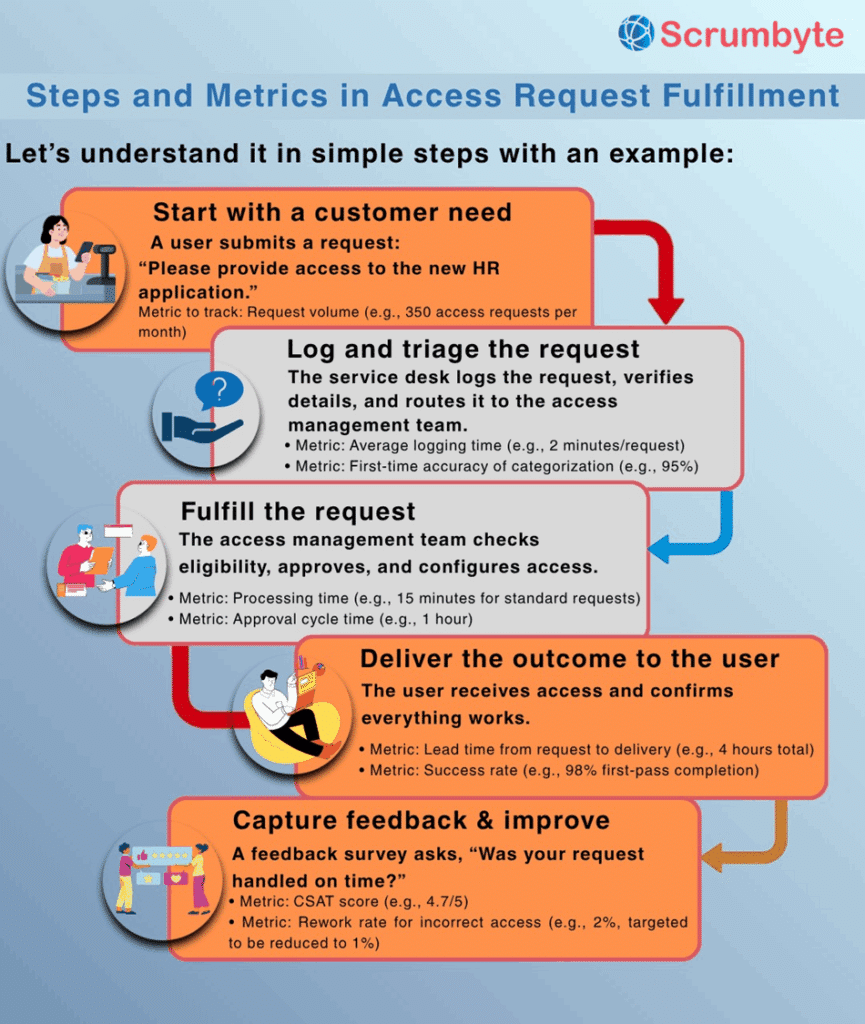
When you map this entire flow – from request → triage → fulfillment → delivery → feedback – you’ve essentially mapped the value stream for that service.
It becomes easy to see delays, automation opportunities, or duplicate steps. And that’s exactly how the ITSM Value Stream Framework helps organizations deliver faster, smoother, and more reliable services.

What is a value stream (in ITIL 4)
- A value stream is defined as “a series of steps that an organization undertakes to create and deliver products and services to service consumers”.
- In ITIL 4, value streams represent workflows that move from demand (or opportunity) → through the organization’s activities/practices → to value (outcome) for stakeholders.
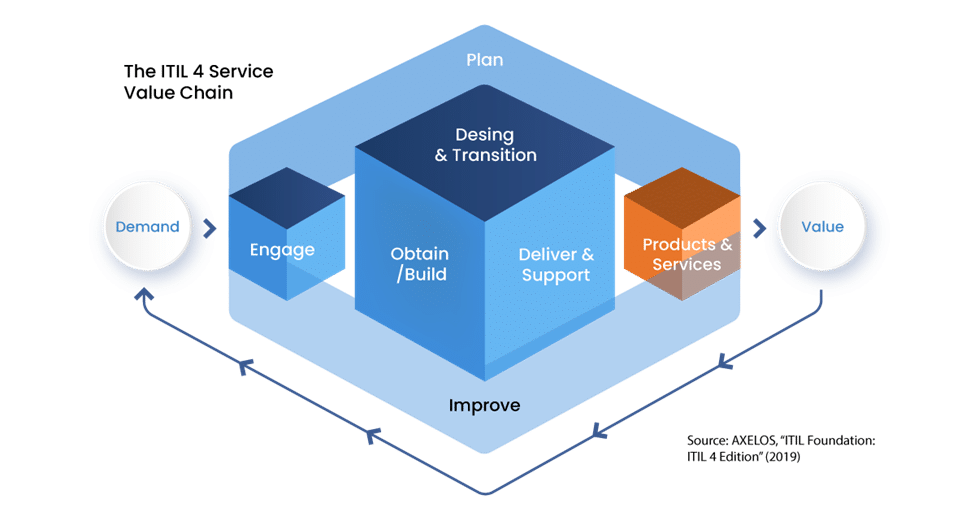
- Value streams are built by linking together the six generic activities of the Service Value Chain (Plan; Improve; Engage; Design & Transition; Obtain/Build; Deliver & Support) in various combinations depending on the scenario.
- Rather than having a rigid fixed number of value streams, organizations define multiple value streams depending on their services, demands, context. One source says: “There are many value streams … different types of work follow different routes.”
Examples of value streams (you may encounter ~8 archetypes)
While ITIL does not publish a canonical “8 value streams” by name many training/reference books identify multiple archetype value streams covering new services and user support. For your planning you could adopt a structure of 8 useful value streams such as:
| # | Value Stream | Description |
| 1 | New Service / Product Delivery | From requirement / demand → design & transition → build/obtain → deliver → value. Covers when you create or launch a new IT service. |
| 2 | Service Change / Change Enablement | Demand for change (new or update) → engage → design & transition → obtain/build → deliver & support → improve. Focuses on safely changing services. |
| 3 | Release & Deployment Management | Specific to releasing new versions/features of existing services: design, build, test, deploy, transition, support. |
| 4 | Incident Resolution / Live Service Restoration | Demand (incident) → engage (service desk) → deliver & support (investigate, restore) → value → improve (lessons) – a typical support-oriented stream. |
| 5 | User Request Fulfilment / Service Request | Demand (user request) → engage → deliver & support (fulfil request) → value → improve. For standard requests (passwords, access, etc). |
| 6 | Problem Management / Root-Cause Fix | Demand (repeated issues or alerts) → engage → design/new build/fix → transition → deliver & support → improve. Focused on reducing underlying causes. |
| 7 | Knowledge & Self-Service Enablement | Demand (need for know-how) → design & build knowledge articles/self-service tools → deliver/support (make available) → value → improve. Ensures the organisation can shift left and reduce load. |
| 8 | Service Improvement / Continual Improvement | Demand (need for improvement) → plan/improve → design & build improvement initiatives → deliver → value → continue improvement. Focus on optimisation, adaptation, culture. |
These eight provide a practical way to categorize your value streams internally (especially for your consultancy and ITSM toolkits).
Key differences & improvements: ITIL v3 → ITIL 4 (with respect to value streams)
For people transitioning from ITIL v3 (which was more process-centric) to ITIL 4, here are the important shifts:
- From “Processes” to “Value Streams & Practices”: In ITIL v3 you had many processes (Incident, Change, Problem, etc.). ITIL 4 moves to “practices” (capabilities) + value streams (flows) that use these practices. The shift emphasizes value delivery and end-to-end flow, not just individual process performance.
- End-to-end workflow viewpoint: Value streams start with demand/opportunity and end with value. This means focusing on the entire life cycle (and not just ticket handling, or “incident → resolution”).
- Integration with agile, DevOps, Lean: Value streams elegantly bridge with lean/DevOps thinking (flow, reduce waste, shift left). ITIL 4 explicitly brings these in.
- Flexibility & context: Instead of attempting to map every possible process, you define value streams per service or per scenario. This allows tailoring.
- Improvement built-in: Many value streams include a built-in “improve” step rather than improvement being an afterthought.
- Focus on customer/consumer experience and outcomes: Value streams emphasize what the consumer/stakeholder receives, not just internal activity.
Here’s an elaboration on basic value stream concepts within the ITIL 4 world – how to understand them, key elements, and how you might apply them in your context.
What is a value stream (In the ITIL 4 Context)?
- A value stream is defined in ITIL 4 as “a series of steps that an organization undertakes to create and deliver products and services to consumers.”
- The concept emphasizes that value isn’t just produced by isolated processes; it is delivered by workflows that span across multiple activities, practices and teams – from demand (or opportunity) through to value realization.
- Value streams are a key part of the “Service Value System” (SVS) in ITIL 4. They connect demand → value via the service value chain.
Key elements of a value stream
Here are the major components to understand when you think about value streams:
| Element | Description |
| Demand/Trigger | The value stream starts when there’s a demand, an opportunity, a request, or a trigger that initiates work. |
| Steps/Activities | The series of steps the organization undertakes: they include actions from various practices, moving from input through transformations to output. |
| Value-adding vs Non-value adding | One goal is to identify and eliminate waste – those steps that do not add value from the stakeholder’s perspective. |
| Flow and Lead Time | The stream should ideally flow smoothly; bottlenecks, delays, and hand-offs add cost or reduce value. Many value stream mapping techniques focus on lead time, throughput, delays. |
| Practices and Processes | The steps draw on ITIL practices (or organizational practices) rather than isolated processes. Value streams integrate practices into end-to-end flows. |
| Outcome / Value Realization | The stream ends when the stakeholder (customer, user, business) gets the value – e.g., a restored service, fulfilled request, new capability. |
| Improvement Feedback Loop | After the value is delivered, there are opportunities to look back, improve the stream, remove waste, and optimize. |
Why does this matter? (especially for your work at a product company or consulting)
- If you’re building ITSM toolkits (for example for service desks, PMO, etc.), framing work in terms of value streams helps shift perspective from “process boxes” to “flow that delivers value to stakeholders”. This aligns with your continuous-improvement mindset.
- When you integrate AI-driven automation (if you have an interest in AI in ITSM), value streams help identify where automation/bots can add most value (e.g., eliminate manual hand-off, reduce lead time).
- For organizations you consult with, helping them map their value streams gives a tangible way to show “end-to-end” value, point out waste, measure lead time/throughput – much more concrete than abstract process maturity.
- Because your experience spans staffing, PMO, vendor management, you can use value stream maps as a tool in engagements (for example: mapping the staffing-on-boarding value stream, vendor onboarding value stream, incident-to-resolution value stream) and show measurable improvements.
Basic steps to map a value stream
Here’s how you might guide an organization (or yourself) to map a value stream:
- Identify the value stream you want to map (e.g., “Service Request Fulfilment for End Users”).
- Define the trigger/demand (what causes the stream to start) and the value outcome (what ends it).
- List the high-level steps/activities from trigger → through various teams/practices → to outcome.
- Detail each step (what tasks/actions, which practice(s) involved, what input, what output). Use value stream mapping tools (flow chart, Kanban board) as referenced in sources.
- Identify waste/non-value adding steps (delays, rework, hand-off, waiting) and bottlenecks.
- Propose improvement actions (eliminate steps, automate, shift left, reduce lead time).
- Define metrics to measure performance (lead time, throughput, first-time fix, cost) and set up governance/monitoring.
- Govern continual improvement – iterate the value stream, monitor, adapt. The “Improve” activity in the service value chain is relevant here.
Let us look at how you would think keeping the above 8 points in mind for “Service Request fulfilment for end users – Access to HR application”. Let us walk through it and then have a detailed example that follows.
Detailed Example
1. Identify the value stream you want to map
Value Stream: “Service Request Fulfilment for End Users – Access to HR Application”
This defines the scope and ensures everyone is aligned on what you’re mapping.
2. Define the trigger/demand and the value outcome
- Trigger/Demand:
An employee submits a request: “Please provide access to the HR application.” - Value Outcome (End State):
The user receives access, verifies it works, and reports satisfaction (value delivered).
3. List the high-level steps/activities from trigger → to value outcome
- User submits access request
- Service Desk logs and triages request
- Access Management reviews and approves request
- Access is configured/provisioned
- User receives access and validates or confirms success
- Feedback collected and improvements logged
These are the macro steps, not the detailed tasks.
4. Detail each step (tasks, practices involved, inputs & outputs)
Step 1 – User submits request
- Practice: ITIL Service Request Management
- Input: User need for HR system
- Tasks: Fill request form → submit
- Output: New request created
- Tool: ITSM portal/service catalog
Step 2 – Log & Triage
- Practice: Service Desk, Categorization, Prioritization
- Tasks:
- Validate user details
- Categorize request
- Assign to Access Management
- Input: Submitted request
- Output: Categorized & routed request
Step 3 – Review & Approve
- Practice: Access Management, Change Enablement (if required)
- Tasks:
- Check eligibility
- Notify approver
- Approve or reject
- Input: Assigned request
- Output: Approval decision
Step 4 – Configure Access
- Practice: Identity & Access Management
- Tasks:
- Provision access
- Update rights
- Confirm completion
- Input: Approved request
- Output: Access configured
Step 5 – Deliver Outcome to User
- Practice: Service Request Management
- Tasks:
- Notify user
- User tests login
- Input: Configured access
- Output: User confirms success
Step 6 – Feedback & Improve
- Practice: Service Level Management, Continual Improvement
- Tasks:
- Send CSAT survey
- Capture issues
- Log improvement opportunities
- Input: Completed request
- Output: Structured feedback
5. Identify waste, non-value-adding activities & bottlenecks
Common issues found:
| Waste Type | Example in Access Request Flow |
| Waiting | User approval takes 1 hour even for standard access |
| Rework | 5% of requests returned due to incomplete forms |
| Handoffs | 3 handoffs between teams cause delays |
| Manual steps | Manual provisioning instead of automation |
These areas slow down service delivery and reduce user satisfaction.
6. Propose improvement actions
Improvement Opportunities:
- Automate provisioning for standard roles
- Shift Left: Pre-populated templates reduce incorrect submissions
- Eliminate unnecessary approvals for low-risk access
- Introduce auto-routing based on request type
- Set SLA-based triggers to escalate stuck requests
Expected Gains:
- Reduce lead time from 4 hours to <1 hour
- Reduce rework from 5% to 1%
- Increase first-pass completion to 99%
7. Define metrics to measure performance
Key metrics for this value stream:
- Lead Time: Total time from request → fulfillment
- Processing Time: Time actively worked (e.g., 25 minutes)
- Throughput: Requests completed per month
- First-Time Completion Rate: e.g., 98%
- Rework Rate: e.g., target <1%
- CSAT Score: e.g., 4.7/5
- Cost per Request: Time × resource cost
Governance Setup:
- Weekly dashboards
- Monthly review meetings
- Alerts for SLA deviations
8. Govern Continual Improvement
This step ensures the value stream stays healthy.
- Monitor lead-time trends
- Review recurring issues
- Implement automation in phases
- Validate improvements with data
- Update SOPs and workflows
- Link improvement to ITIL’s “Improve” activity in the Service Value Chain
Outcome:
A continuously evolving, faster, error-free value stream that delivers higher value to end users.
Lets look at another example from a different perspective
A well-defined example of mapping a value stream
Let us look up the basic steps to map a Value Stream (With an Example shown below). This example was shown in the beginning of the blog as an image and expanded here for clarity.
Mapping a value stream means visualizing how workflows from the moment a customer makes a request until the final value is delivered. Below are the basic steps, explained with the Access Request Fulfillment example for clarity:
Identify the Customer Trigger
Every value stream begins with a trigger – the moment a need arises.
Example:
An employee needs access to the new HR application and submits a request.
Why this matters:
The trigger defines when the value stream starts and what “value” means to the customer (quick and correct access).
Typical Metrics:
- Demand volume (e.g., 350 access requests/month)
- Entry quality (e.g., 90% requests filled with complete information)
Map the Workflow From Request to Delivery
List every activity that happens from the trigger to the final output.
Example workflow steps:
- Submit request
- Service desk logs and categorizes
- Access team reviews and approves
- Access configured
- User validates access
- Survey sent and feedback collected
Why this matters:
This step shows the actual flow, not the theoretical one – exposing delays, loops, or handoffs.
Typical Metrics:
- Number of steps
- Handoff points
- Waiting times between steps
Capture People, Systems & Hand-offs
Identify who performs each step and which tools or systems support it.
Example:
- Service desk → logs request in ITSM tool
- Access management team → approves in identity management system
- Automation script → provisions access
- User → confirms via email
Why this matters:
This highlights delays, unnecessary approvals, system dependencies, and manual work.
Typical Metrics:
- Handoff count (e.g., 3 handoffs)
- Automation percentage (e.g., 40% handled automatically)
Measure Lead Time & Processing Time
For each step, capture:
- Processing time = Time spent working
- Waiting time = Time spent idle
- Lead time = Total from request to completion
Example metrics:
- Logging time → 2 minutes
- Approval time → 1 hour
- Access configuration → 15 minutes
- Total lead time → 4 hours
Why this matters:
Value streams show that most delays happen in waiting, not working.
Identify Waste, Bottlenecks & Opportunities
Use the mapped workflow + metrics to highlight problem areas.
Example insights:
- Approval time contributes 70% of total delay.
- 5% of requests bounce back due to missing information.
- Manual steps slow down access creation.
Why this matters:
This step pinpoints where to focus improvement efforts.
Define the Ideal Future-State Stream
Create a simplified, optimized version of the value stream.
Example future state:
- Auto-approval for low-risk roles
- Pre-filled request templates
- Automated provisioning for standard access
Expected Improvements:
- Total lead time reduced from 4 hours → 45 minutes
- Rework rate drops from 2% → 0.5%
- User satisfaction rises from 4.7 → 4.9
Create an Action Plan to Close the Gap
Convert insights into a practical improvement roadmap.
Example action plan:
- Implement automation for standard access
- Update SOPs for consistent categorization
- Train service desk to reduce errors
- Introduce weekly review of access-related incidents
Why this matters:
The value stream becomes a continuous-improvement engine – not a one-time exercise.
Common pitfalls and things to watch
- Mapping too narrowly: If you focus on a small process but ignore upstream/downstream steps, you may optimise one part but slow the overall flow. ITIL 4 emphasizes the end-to-end stream rather than siloed process.
- Over-complexity: Don’t drown in too many micro-steps early. Start with high-level, then drill down.
- Not linking to value: It’s easy to get caught in “this is a good process” rather than “does this step add value to the user/customer?”
- Ignoring culture/people: Flow is not just tools/processes, it’s about people, roles, teamwork.
- Metrics without context: Measuring lead time is good, but you need context: what is acceptable, what variation is acceptable, what is cost.
Re-drawing value streams once and forgetting them: They need revision as services, technologies, customer-needs evolve.
Closing Statement
Understanding the ITSM Value Stream Framework empowers working professionals to see beyond individual processes and focus on the complete flow of value delivered to customers. By mapping each step from demand to delivery – teams gain the clarity needed to remove bottlenecks, streamline collaboration, and continuously improve service performance. The more the complex IT environments become, adopting a value-stream mindset isn’t just a best practice – it’s a competitive advantage. Whether you’re optimizing service request fulfilment, incident response, or change enablement, the value stream approach provides a structured, data-driven way to enhance efficiency, reduce waste, and deliver meaningful outcomes that truly matter to the business.

All rights reserved, 2025 – Vijay Chander Author – Scrumbyte
Comments are closed