
Introduction
Change is constant.
Value is optional – unless Change Enablement is designed intentionally.
Despite modern ITSM platforms and years of process maturity, many organizations still experience the same symptoms:
- High change failure rates despite “approved” changes
- CABs perceived as bottlenecks rather than enablers
- Agile and DevOps teams bypassing governance to maintain speed
- Leadership unable to clearly articulate the value delivered by ITIL Change Management process
ITIL® 4 addresses these challenges directly by reframing Change Management as Change Enablement – a practice focused on enabling safe, fast, and value – driven change. At the center of this shift is the ITIL 4 Change Enablement Value Stream, which describes how organizations convert demand into realized business value.
Let us delve into:-
- How the ITIL 4 Change Enablement Value Stream works end to end
- How demand flows through governance without becoming bureaucracy
- How AI is transforming ITIL 4 Change Enablement value stream in practice
- Real – life examples of value creation
- How organizations can mature ITIL 4 Change Enablement value stream systematically
Understanding the ITIL 4 Change Enablement Value Stream
In ITIL 4, value streams define how value is co-created, not how processes are followed. The ITIL 4 Change Enablement Value Stream represents the coordinated activities required to assess, authorize, implement, validate, and learn from changes – so outcomes matter more than approvals.
This leads to the question, what constitutes “demand” in ITIL 4 Change Enablement value stream?
Demand typically originates from:
- New product features or service enhancements
- Operational improvement initiatives
- Incident and problem trends
- Security vulnerabilities and compliance obligations
- Technology, lifecycles and modernization programs
What does “value” mean?
To clarify, value is not just the successful closure of a change record.
Now value is measured and realized. The following diagram describes the concept in detail.
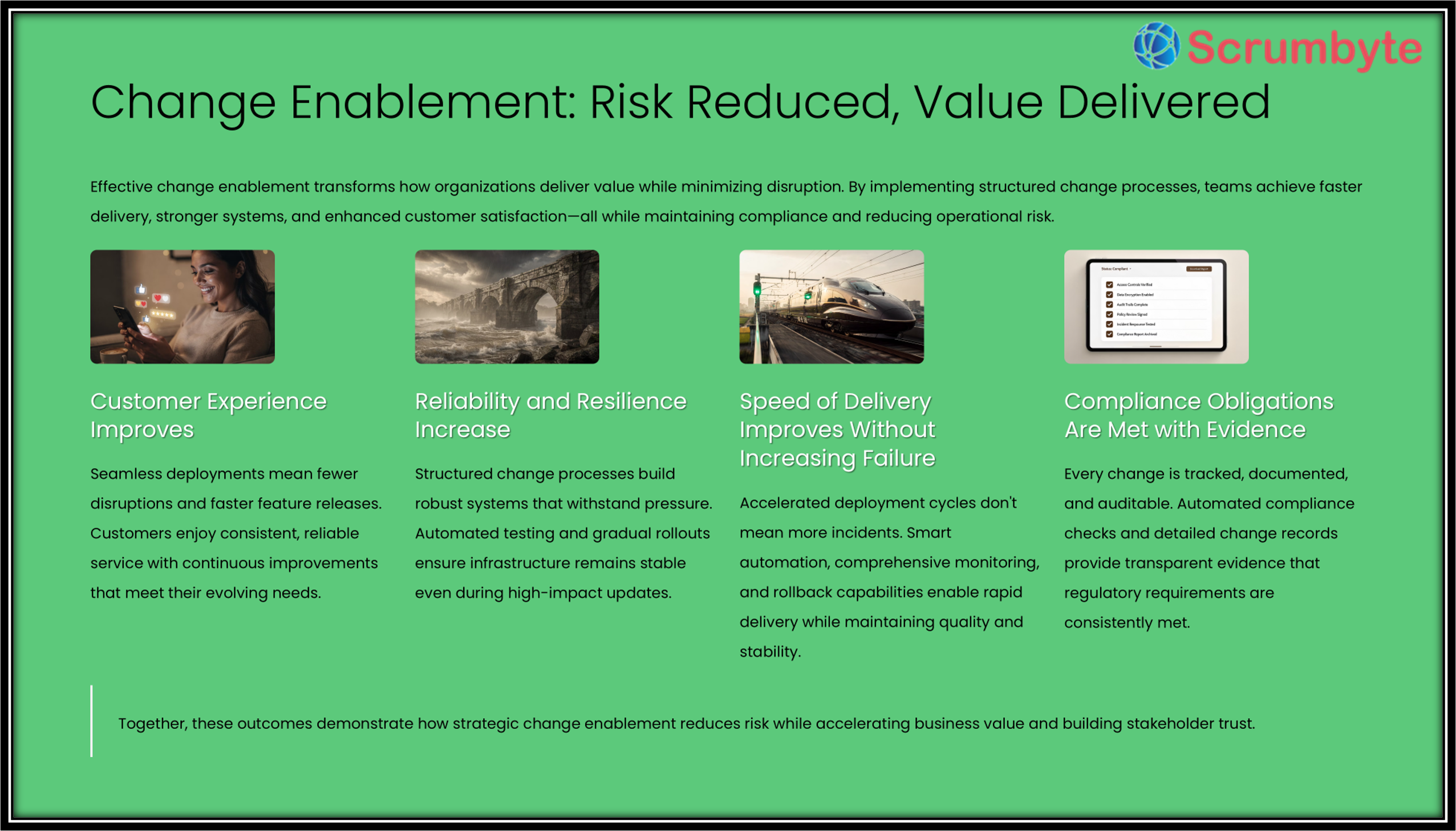
This outcome focus is the defining characteristic of the ITIL 4 Change Enablement Value Stream.
Why does Traditional Change Management Struggle?
Earlier (would not use legacy) change models assume:
- All changes carry equal risk
- Control requires human approval
- More governance means fewer failures
In reality, this leads to:
- Slow lead times
- Approval fatigue
- Shadow IT
- High failure rates despite “compliance”
ITIL 4 challenges this thinking by promoting:
- Risk – based decision – making
- Automation over manual control
- Flow efficiency over hierarchical approval
- Learning over blame
The ITIL 4 Change Enablement Value Stream: Step by Step
1. Demand Identification and Intake
Change demand is captured with clarity—what is changing, why, and what outcome is expected. The focus is on value framing, not form completion.
Output: Qualified change demand aligned to a service or product.
2. Change Classification and Routing
Changes are classified as Standard, Normal, or Emergency, determining the appropriate governance path.
Output: Correct workflow and ownership without unnecessary friction.
3. Value and Risk Assessment
The organization explicitly assesses:
- Business and customer impact
- Service and operational risk
- Security and compliance exposure
- Technical complexity and dependencies
Output: A clear value hypothesis and risk – informed decision context.
4. Planning and Change Design
Planning focuses on execution readiness:
- Implementation steps
- Testing and validation approach
- Rollback strategy
- IT Communication plan
Output: A change that is ready to execute, not just approved.
5. Authorization (Right – Sized Governance)
Authorization is proportionate to risk:
- Standard changes are pre – approved
- Normal changes follow service or product ownership
- Emergency changes use expedited authority models
Output: Fast decisions with accountable governance.
6. Build, Test, and Release Preparation
Testing and readiness checks ensure the change can be deployed safely and observed effectively.
Output: Deployment – ready change with confidence.
7. Implementation and Deployment
Changes are executed with controlled rollout, monitoring, and communication.
Output: Change implemented with minimal disruption.
8. Validation and Early Life Support
Success is validated using outcomes, not assumptions.
Output: Verified improvement or risk reduction.
9. Review, Learning, and Improvement
Post – implementation learning feeds standardization and automation.
Output: Fewer future risks, faster future changes.
10. Value Measurement and Reporting
Metrics close the loop between demand and value.
Output: Executive – ready evidence of value creation.
How AI Is Enabling Change Enablement
AI fundamentally changes the economics of Change Enablement. It reduces human overhead while strengthening governance, enabling organizations to scale change without scaling risk.
AI enables:
- Faster, cleaner demand intake
- Consistent risk classification
- Intelligent conflict detection
- Automated evidence generation
- Continuous learning and standardization
- Clear linkage between change and outcomes
AI does not replace ITIL 4 Change Enablement Value stream – it industrializes it.
AI Capability Mapping Across the ITIL 4 Change Enablement Value Stream
| Value Stream Stage | AI Capability | Practical Enablement | Example Tools |
| Intake & Qualification | AI summarization & enrichment | Auto – creates high – quality change records | ServiceNow Now Assist, Jira SM AI, Freddy AI |
| Classification | Pattern recognition | Recommend Standard/Normal/Emergency | ServiceNow, BMC Helix |
| Risk Assessment | Predictive scoring | Estimates failure probability & blast radius | ServiceNow Change Intelligence |
| Conflict Detection | Collision analysis | Identifies overlapping changes | ServiceNow AI Agents |
| Planning | Generative drafting | Creates plans, rollback, comms | ServiceNow, Jira AI |
| Authorization | Decision support | Explains risk context to approvers | ServiceNow, BMC Helix |
| Validation | Outcome correlation | Confirms KPI improvement | ServiceNow Analytics |
| PIR & Learning | Automated insights | Identifies standardization candidates | ServiceNow, BMC Helix |
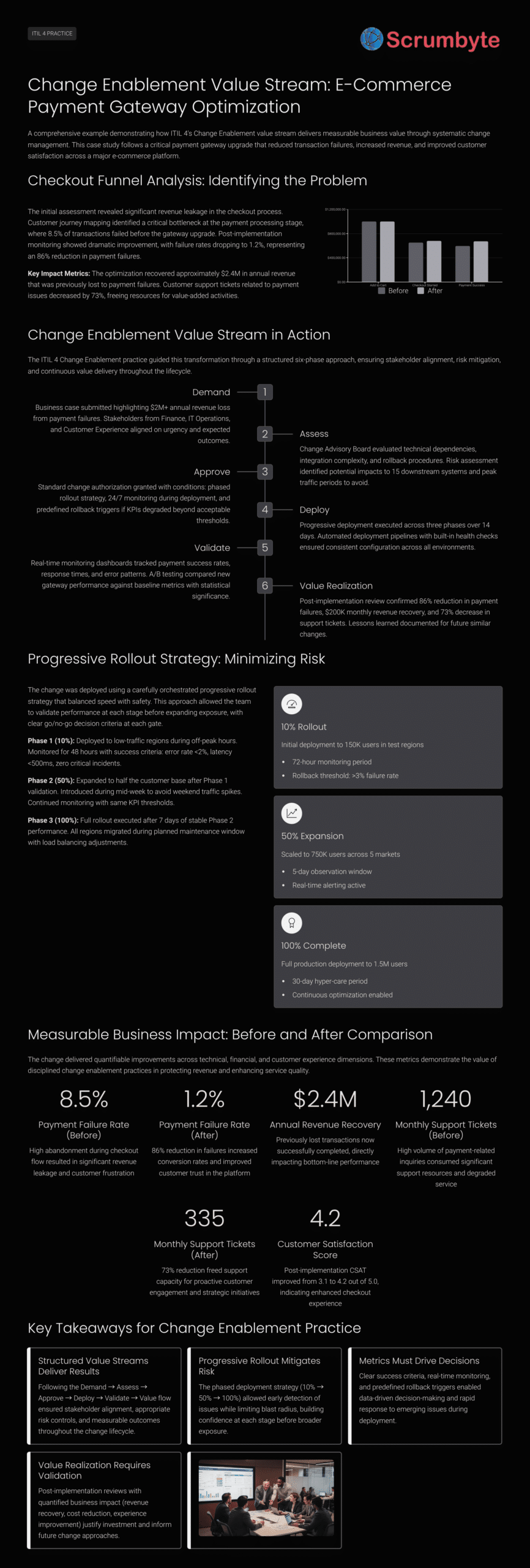
Example (Real – Life): E – commerce Checkout Payment Fix (Normal Change)
Let us first look into a real work example of a E-Commerce Checkout Payment Fix, which is a normal change and work through the entire ITSM value stream.
Context (this is the problem statement if one wants to call it that)
An e – commerce company sees rising payment failures during peak hours. The product team demands a fix that improves conversion and reduces customer complaints.
Demand
- Trigger: Customer complaints + monitoring alerts show checkout failures.
- Demand statement: “Reduce payment failures during peak hours.”
- Target outcome: Increase successful payment rate and reduce cart abandonment.
Below is described the complete step-by-step flow
Step – by – step flow (demand to value)
- Intake & classification
- Using problem management process to know the source.
- Logged as Normal change (production impact, customer – facing).
- Related items linked: ITIL incident management process trends, problem record, monitoring evidence.
- Value & risk framing
- Value hypothesis: “Reduce payment failure from 2.5% to <1%”
- KPI: payment success rate, revenue uplift, customer complaints.
- Assessment & planning
- Root cause: payment gateway timeout due to retries and poor circuit – breaker tuning.
- Plan: implement circuit breaker + revise retry strategy + increase connection pool.
- Test plan: load test + simulated gateway latency.
- Rollback: revert config flags + revert deployment.
- Authorization
- Approval by service owner + product owner (risk medium).
- Scheduled in a low – traffic window; comms approved.
- Build, test, prepare release
- Feature flag implemented.
- Load tests show stable behavior at peak load.
- Monitoring dashboards updated; alert thresholds tuned.
- Implementation
- Deploy to production with gradual rollout (10% → 50% → 100%).
- Real – time monitoring during rollout.
- Validation
- Payment failures drop to 0.8% within 24 hours.
- No increase in error spikes or latency.
- Review
- PIR finds one near – miss: alerting should have included gateway saturation metric earlier.
- Improvement: create Standard change model for similar payment tuning changes.
- Value realization
- Measured revenue uplift and fewer support tickets.
- Change becomes a reusable pattern with automated checks.
The following diagram showcases the complete flow neatly.
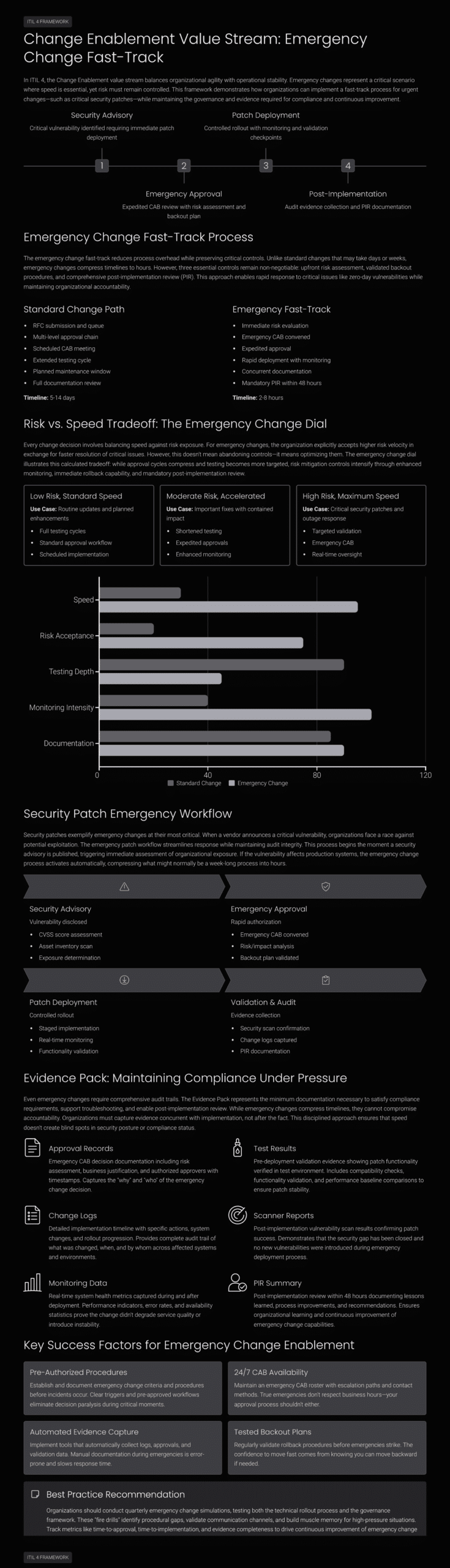
Now that we have seen a normal change, let us look at how an emergency change performs in the same value stream flow. Below is the example.
Critical Security Patch for VPN Gateway (Emergency Change)
Context
A critical vulnerability is announced affecting a VPN gateway used by employees and vendors. There is credible exploitation activity in the wild. The organization must patch quickly while minimizing downtime.
Demand
- Trigger: Security advisory + threat intel.
- Demand statement: “Patch vulnerability within 24 hours to reduce exposure.”
- Value outcome: Risk reduction + compliance, continued secure access for remote work.
Step – by – step flow (demand to value)
- Intake & classification
- Logged as Emergency change due to active risk.
- Linked to security incident / vulnerability ticket.
- Value & risk framing
- Value is risk reduction, not feature delivery.
- KPI: time – to – remediate (TTR), exposure window duration, successful patch compliance.
- Assessment & planning (fast but disciplined)
- Identify affected versions and impacted regions.
- Plan includes:
- Immediate patch in staging
- Smoke testing authentication + MFA + split – tunnel policies
- Backout plan: rollback image snapshot + failover to standby appliance
- Emergency authorization
- Approved by emergency change authority (security lead + infra lead).
- CAB is bypassed; accountability is explicit.
- Build, test, prepare
- Patch applied to staging.
- Validate:
- User login flows
- MFA success
- Key VPN routes and DNS resolution
- Implementation
- Implement during agreed maintenance window (or immediate if risk requires).
- Execute runbook; monitor authentication failures and tunnel stability.
- Validation
- Confirm vulnerability remediation (scanner + version check).
- Confirm access stability and no spike in helpdesk tickets.
- Post – implementation review
- Review what worked and what could be faster next time.
- Improvements:
- Maintain “hot standby” architecture always ready
- Pre – approved emergency runbooks
- Automated vulnerability – to – change workflow
- Value realization
- Exposure window reduced.
- Audit evidence stored (approval trail, test results, implementation logs).
- Reduced risk becomes visible, measurable value.
The image below captures the full essence.
ScrumByte AI – Enabled ITIL 4 Change Enablement Value Stream Maturity Model
For a deeper understanding of how to conduct a proper maturity self assessment, with Service management as an example explore our post ITSM Maturity Assessment. Additionally Scrumbyte has its own custom ITSM Maturity Self-Assessment for Small and Mid-Size companies using its own unique parameters with examples for various streams. Moving further into ITIL 4 change enablement value stream, our new model has the following levels that are measurable. Your organization could also build its own levels based on similar lines to understand where you stand, and adjust accordingly to suit your company’s goals.
Level 1 – Ad Hoc Control
- Manual approvals
- High failure rates
- CAB – centric governance
- No outcome measurement
Level 2 – Process – Defined
- Standard/Normal/Emergency defined
- Basic workflows
- Still approval heavy
Level 3 – Value – Stream Aligned
- Demand – to – value visibility
- Risk – based governance
- Measurable outcomes
Level 4 – AI – Assisted Enablement
- AI – driven intake and classification
- Predictive risk scoring
- Automated evidence
- Reduced CAB load
Level 5 – Intelligent, Adaptive Change
- Self – optimizing standard changes
- Real – time risk adjustment
- Continuous learning loops
- Change as a competitive advantage
Final Thought
Change will always be inevitable. The differentiator is how effectively your organization converts change demand into business value.
The ITIL 4 Change Enablement Value Stream, strengthened with AI, allows organizations to move beyond control – driven governance toward outcome – driven enablement.
At ScrumByte, we see Change Enablement not as an ITSM function—but as a strategic capability that directly influences speed, resilience, trust, and competitiveness.

Vijay Chander is the founder of Scrumbyte, and is a senior IT strategy and service management consultant with over 30 years of global experience across Fortune 100 organizations including Microsoft, Caterpillar, First Data and SWIFT. He has led large-scale enterprise transformations spanning ITSM, architecture, product development, and managed services
Comments are closed