
Introduction
In today’s fast-paced digital environment, efficient IT Asset Management (ITAM) is crucial for organizations to track, manage, and optimize their IT assets. ITAM involves the lifecycle management of physical and digital assets—such as hardware, software, and cloud resources—ensuring that they are used efficiently and remain compliant with regulatory requirements. Traditionally, ITAM has been a labor-intensive process, but the rise of Artificial Intelligence (AI) is transforming this field. AI enhances ITAM through automation, predictive analytics, and intelligent insights, enabling organizations to improve accuracy, cost management, and decision-making.
This article explores the fundamentals of IT Asset Management, the role of AI in revolutionizing ITAM, examples of AI-driven ITAM applications, and a comparison of leading tools in the market, concluding with insights into the future of AI in ITAM.
1. What is IT Asset Management?
IT Asset Management (ITAM) is the strategic approach to managing and optimizing an organization’s IT assets throughout their lifecycle. This lifecycle includes procurement, deployment, maintenance, and retirement. ITAM aims to ensure that assets are utilized efficiently, compliance requirements are met, costs are controlled, and risks are mitigated.
Key Goals of ITAM:
- Inventory Control: Ensures all assets are tracked and accounted for.
- Cost Management: Manages spending by monitoring asset utilization and eliminating redundancies.
- Risk Management: Minimizes compliance risks and reduces vulnerabilities by keeping track of asset lifecycle status.
- Optimization: Helps organizations achieve maximum value from their IT investments by identifying underused or overused assets.
2. How AI is Transforming IT Asset Management
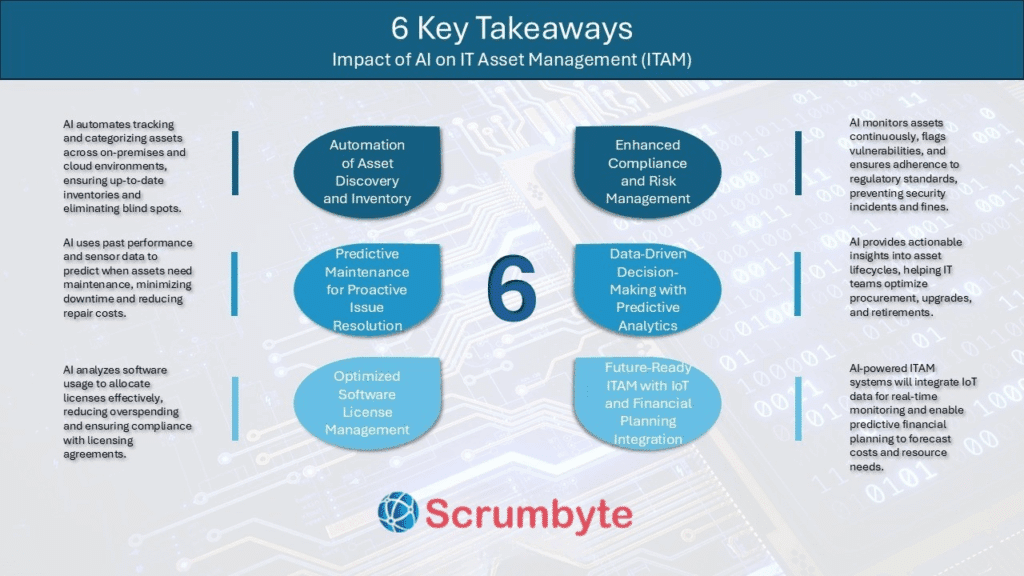
AI is introducing significant advancements in ITAM by automating time-consuming tasks, enhancing data accuracy, and providing predictive insights. With AI, ITAM tools can automate asset discovery, improve data analytics, and offer real-time insights that enable better decision-making. Below are some key areas where AI is making an impact:
a. Automated Asset Discovery and Inventory
One of the most tedious tasks in ITAM is tracking down all assets within an organization. AI-powered ITAM solutions can automate asset discovery, using machine learning and network-scanning algorithms to detect both on-premises and cloud-based assets in real-time. This provides an accurate, up-to-date inventory, reducing the chances of untracked assets and eliminating blind spots.
Example: An AI-based asset discovery tool can automatically detect newly added devices on the network, classify them, and add them to the asset registry without human intervention.
b. Predictive Maintenance
AI enhances predictive maintenance by using data from past maintenance activities and sensor data to predict when assets may require servicing. This allows IT teams to address issues before they become significant problems, minimizing downtime and reducing maintenance costs.
Example: By analyzing device usage patterns and error logs, an AI-powered ITAM tool can predict when a server is likely to experience hardware issues, allowing IT staff to proactively schedule maintenance.
c. Software License Optimization
Software license management is a crucial aspect of ITAM, as it helps organizations avoid overpaying for unused licenses or incurring penalties for non-compliance. AI can analyze usage data and recommend adjustments in licensing based on actual demand.
Example: An AI-driven license optimization tool can automatically detect underused software licenses and suggest reallocating them or downgrading to less costly plans, saving the organization on unnecessary expenses.
d. Compliance and Risk Management
AI can assist in compliance by continuously monitoring assets and generating alerts for policy violations or potential risks. By automating compliance checks, organizations can ensure they meet regulatory standards and avoid potential fines.
Example: AI can scan software inventories and cross-reference them with a compliance database to detect unauthorized software, prompting corrective actions to maintain compliance.
e. Enhanced Decision-Making with Predictive Analytics
AI-powered ITAM solutions leverage predictive analytics to provide deeper insights into asset usage patterns, enabling IT managers to make informed decisions on asset procurement, retirement, and upgrades.
Example: By analyzing historical usage data, AI can recommend purchasing more licenses during peak periods or retiring hardware nearing the end of its lifecycle.
3. Comparative Analysis of AI-Enhanced ITAM Tools
Here’s a look at some of the leading ITAM tools incorporating AI functionalities, comparing their unique features and strengths:
| Tool | Features | AI Capabilities | Best For |
| ServiceNow ITAM | Asset discovery, lifecycle management, license optimization, and automated workflows | AI-powered asset discovery and predictive analytics | Large enterprises |
| IBM Maximo | Comprehensive asset lifecycle management, predictive maintenance, and real-time monitoring | Machine learning for predictive maintenance | Industries with physical assets |
| Cherwell ITAM | Cloud and on-premises asset management, license tracking, and compliance reporting | AI-driven insights and automation for software licenses | Mid-sized to large organizations |
| Ivanti ITAM | Asset discovery, software license management, and risk management | AI-based predictive analytics for inventory optimization | IT and manufacturing sectors |
| ManageEngine ITAM | Automated asset discovery, software license management, and compliance tracking | Basic AI capabilities for asset classification | Small to mid-sized organizations |
Key Takeaways:
- ServiceNow ITAM: Known for scalability, ServiceNow offers AI-driven predictive analytics, making it ideal for large enterprises with complex asset portfolios.
- IBM Maximo: Highly suitable for industries needing predictive maintenance on physical assets, such as manufacturing.
- Cherwell ITAM: Focuses on software asset management and license optimization with AI insights, serving mid-sized to large organizations.
- Ivanti ITAM: Integrates AI-based analytics tailored for inventory control, particularly helpful in sectors where asset usage fluctuates.
- ManageEngine ITAM: A cost-effective option for smaller organizations needing basic AI capabilities for asset discovery and classification.
4. The Future of AI in IT Asset Management
As AI technology continues to advance, its impact on IT Asset Management is expected to grow, leading to more innovative solutions and capabilities. Here are some of the anticipated developments:
a. Autonomous ITAM Systems
With the integration of AI and automation, future ITAM systems could become fully autonomous, capable of managing assets throughout their lifecycle with minimal human intervention. Autonomous systems would detect new assets, assess usage, conduct predictive maintenance, and retire assets when they are no longer viable.
b. Improved Integration with IoT Devices
As IoT devices become more prevalent, AI-powered ITAM systems will need to manage these devices more effectively. AI can analyze data from IoT sensors to monitor asset health, usage patterns, and potential security threats, expanding ITAM capabilities beyond traditional IT assets.
c. Enhanced Security and Compliance Monitoring
AI will play an increasingly important role in security and compliance by continuously monitoring for vulnerabilities, unauthorized software, and security incidents. Future ITAM systems could leverage AI to assess compliance risk in real-time, reducing the likelihood of data breaches and regulatory fines.
d. Personalized Asset Management
AI will enable more personalized ITAM approaches by analyzing the needs and usage patterns of individual users. This could lead to tailored asset provisioning, where employees receive customized software and hardware assets based on their roles, improving productivity and satisfaction.
e. Proactive Financial Management
AI’s predictive capabilities could also support financial planning for IT assets by forecasting future costs and resource needs based on historical data. This would allow IT departments to make proactive budget adjustments, optimize costs, and avoid unplanned expenses.
Conclusion
AI is transforming IT Asset Management, driving efficiency, enhancing compliance, and empowering IT teams to make data-driven decisions. With AI, ITAM tools are evolving from static systems into intelligent platforms capable of automating asset discovery, predicting maintenance needs, optimizing software licenses, and ensuring compliance.
As organizations continue to adopt AI-powered ITAM solutions, they gain greater control over their assets, enabling them to operate more efficiently, reduce costs, and mitigate risks. The future of ITAM looks promising, with AI anticipated to bring even more autonomy, security, and personalization to asset management. Embracing AI in ITAM will be essential for organizations aiming to stay competitive in a rapidly evolving digital landscape.
all rights reserved – Vijay Chander 2024
Comments are closed