
Emergency Change Management
Emergency change management is a critical aspect of organizational operations that deals with the efficient handling of sudden, urgent situations that require immediate action. It is a specialized process designed to address emergencies such as system failures, security breaches, or major disruptions to business continuity.
Unlike regular change management processes, emergency change enablement (as against change management), as defined within ITIL 4 Change Enablement, requires rapid decision-making, prioritization, and execution to mitigate the impact of critical situations and restore service as quickly as possible. This approach emphasizes effective communication, proportionate risk assessment, clear authorization, appropriate documentation, focused testing, and post-implementation review to ensure that emergency changes are implemented safely despite compressed timelines.
By applying the principles of ITIL 4 Change Enablement, organizations can balance speed with control—responding swiftly to unforeseen events while minimizing unintended consequences and strengthening operational resilience.
Let us consider the 10 most important points:
Urgency

Emergency change management is necessary when a critical situation arises that requires immediate action. It typically involves situations such as system failures, security breaches, or major disruptions to business operations.
Rapid Response
Emergency change management focuses on quickly identifying and implementing the necessary changes to address the issue at hand. This may involve bypassing or streamlining normal change management processes to expedite the resolution.
Risk Assessment
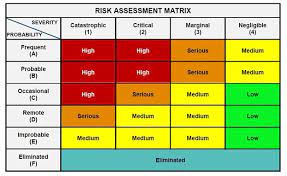
Despite the urgency, it is important to conduct a rapid but thorough risk assessment to understand the potential impact of the emergency change. Risk assessment helps in determining the appropriate actions and mitigating any unintended consequences.
Stakeholder Communication

Effective IT communication is crucial during emergency change management. All relevant stakeholders, including the IT team, management, and affected users, should be promptly informed about the situation, the planned changes, and the expected impact.
Prioritization
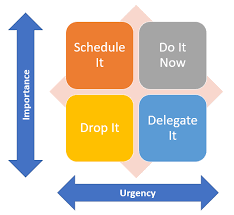
When multiple emergencies occur simultaneously, prioritization becomes essential. A clear understanding of the criticality, urgency and potential impact of each emergency helps in allocating resources and focusing efforts where they are most needed.
Documentation
While time is of the essence, it is still important to document the process. This includes capturing the steps taken, decisions made, and any modifications to existing procedures. Documentation helps in reviewing and learning from the emergency situation for future improvements.
Testing and Validation
Even in emergency situations, it is essential to perform some level of testing and validation to ensure that the changes implemented effectively address the problem without introducing new issues. Typically in your testing and validation process a separate entity can be created to explain the process. This may involve conducting limited tests or leveraging existing knowledge of the system.
Contingency Planning
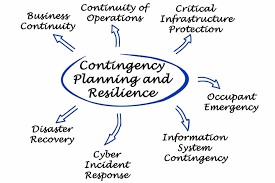
Emergency change management should also include planning for contingencies. In case the initial changes do not fully resolve the problem or new issues arise, having backup plans and alternative approaches can help minimize the impact on operations.
Post-change Evaluation

Once the emergency is resolved and stability is restored, it is important to conduct a post-change evaluation. This involves assessing the effectiveness of the changes, identifying any further improvements, and capturing lessons learned for future emergency situations.
Continuous Improvement

This process should be an opportunity for continuous improvement. Organizations should analyze the root causes of emergencies, identify ways to prevent or minimize their occurrence, and enhance their overall change management processes to handle emergencies more efficiently in the future.
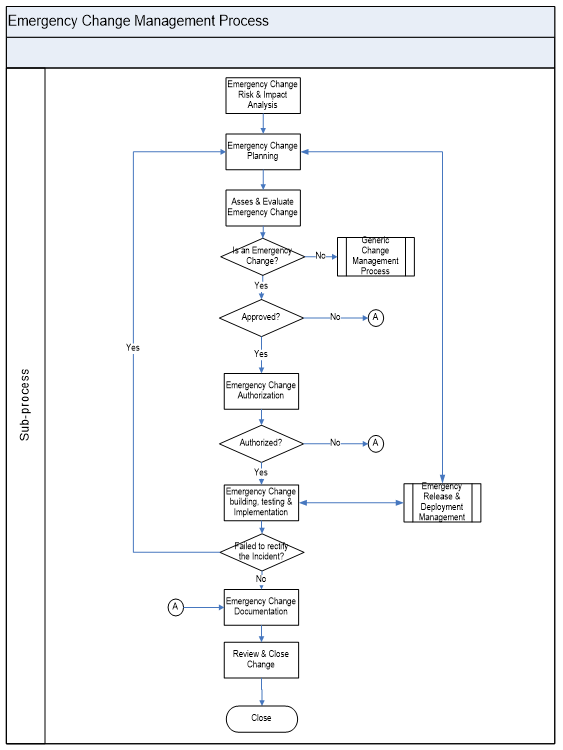
Flowchart Representation
Here is the flowchart for a visual representation of process
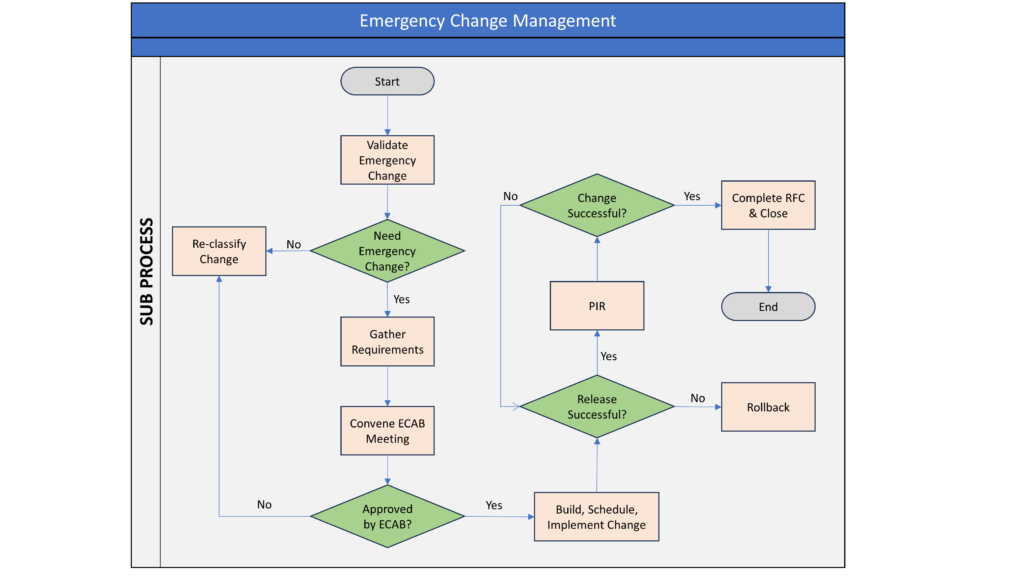
Here is another representation of the Process
For more information check ITIL’s Change Management
Authored by Vijay Chander – All rights reserved – 2023

Comments are closed