
Introduction
As organizations adopt ITIL 4 and modern ITSM practices, one critical question repeatedly surfaces:
“How mature is our ITSM capability, really?”
Many IT teams believe they are “doing ITIL” because processes exist, tools are in place, or tickets are being resolved. Yet persistent issues—slow delivery, repeated incidents, poor user experience, and weak governance—suggest otherwise. This gap between perception and reality is exactly why an ITIL 4–aligned ITSM maturity self assessment is essential.
This blog explains how to design and execute an ITSM maturity assessment grounded in ITIL 4 principles, how maturity is logically measured, and how practical templates can be used to drive meaningful improvement—not just compliance.
What Is an ITIL 4–Based ITSM Maturity Assessment?
An ITSM maturity assessment aligned with ITIL 4 evaluates how effectively an organization applies ITIL 4 concepts across people, processes, technology, and governance to enable value co-creation.
Unlike older, process-heavy ITSM maturity models, ITIL 4 emphasizes:
- Value over process adherence
- End-to-end value streams
- Integration across practices
- Continuous improvement
- Flexibility over rigidity
An ITIL 4–based ITSM maturity assessment therefore focuses not just on whether processes exist, but on:
- How well they enable value creation
- How consistently they are applied
- How effectively they are measured and improved
- How well they integrate across the Service Value System (SVS)
Why ITIL 4 Changes the Way Maturity Should Be Measured
Traditional ITSM maturity models often evaluated practices in isolation:
- Incident Management maturity
- Change Management maturity
- Problem Management maturity
ITIL 4 challenges this siloed thinking.
Key ITIL 4 Shifts That Influence ITSM Maturity Assessment
- From Processes to Practices
Practices include people, skills, partners, information, workflows, and tools—not just procedures. - From SLAs to Value & Experience
Maturity is about outcomes, not just compliance. - From Linear Processes to Value Streams
The real test of maturity is how smoothly workflows across practices. - From Periodic Reviews to Continual Improvement
Improvement must be embedded, measurable, and ongoing.
An effective ITSM maturity assessment must reflect these shifts. To know more about how to execute ITSM process redesign look at our take on the entire procedure to ensure all the right questions are asked and recorded.
ITIL 4 Maturity Levels (Practical Interpretation)
While ITIL 4 does not prescribe a formal ITSM maturity model, most organizations use a five-level structure adapted to ITIL 4 thinking.
Level 1 – Ad Hoc
- Practices are informal and inconsistent
- Heavy reliance on individuals
- Reactive firefighting dominates
- Limited alignment with ITIL 4 concepts
Level 2 – Basic
- Some practices defined
- Inconsistent adoption across teams
- Tool usage exists but lacks governance
- Limited value-stream visibility
Level 3 – Defined
- Practices documented and standardized
- Roles and responsibilities clear
- Service value chain activities identifiable
- Basic metrics and reporting in place
Level 4 – Managed
- Performance actively measured
- Practices integrated across value streams
- Data-driven decision-making
- SLAs, XLAs, and governance actively managed
Level 5 – Optimized
- Continual improvement embedded
- Automation and AI leveraged
- Value streams optimized end-to-end
- Strong focus on experience, outcomes, and adaptability
Not every practice needs to be Level 5. ITIL 4 encourages “fit-for-purpose” maturity, aligned to business context.
ITIL 4–Aligned ITSM Domains for ITSM Maturity Assessment
A combined ITIL 4 + ITSM maturity assessment typically covers the following domains:
1. ITSM Governance & Strategy
- Alignment with business objectives
- Service value system awareness
- Decision-making clarity
- Risk and compliance integration
2. Service Management Practices
- Incident Management
- Service Request Management
- Change Enablement
- Problem Management
- Service Level Management
3. Service Value Streams
- Incident resolution value stream
- Request fulfillment value stream
- Change delivery value stream
- New service onboarding
4. Service Catalog & Self-Service
- Catalog completeness
- Request models
- User experience
- Automation readiness
5. Knowledge Management
- Knowledge lifecycle management
- Shift-left enablement
- AI-assisted knowledge usage
6. Automation, Tooling & Integration
- Workflow automation
- Tool integration
- AI and analytics usage
7. Measurement & Reporting
- KPIs, SLAs, XLAs
- Trend analysis
- Outcome-based reporting
8. Continual Improvement Practice
- Improvement backlog
- CSI governance
- Data-driven prioritization
How Maturity Is Measured: ITIL 4–Aligned Logic
1. Assessment Statements (Practice-Focused)
Each domain is broken into clear, ITIL 4–aligned statements.
Example (Incident Management):
- “Incidents are managed through an end-to-end value stream rather than isolated team workflows.”
- “Incident trends are analyzed to drive continual improvement.”
2. Scoring Scale
Each statement is scored consistently:
| Score | Meaning |
| 1 | Not implemented |
| 2 | Partially implemented |
| 3 | Defined and adopted |
| 4 | Measured and managed |
| 5 | Optimized and continually improved |
3. Evidence-Based ITSM Assessment
Scores must be backed by evidence:
- SOPs and workflows
- Tool configurations
- Dashboards and reports
- Governance forums
- Automation scripts
This prevents “assumed maturity.”
4. Practice-Level and Value Stream Aggregation
Scores are:
- Aggregated at the practice level
- Reviewed across value streams
- Compared for consistency
This highlights silos and weak integration.
Example: Service Request Management ITIL 4 Maturity
ITSM Assessment Statements
- Service requests are offered via a centralized service catalog
- Request models are standardized and validated
- Approvals are risk-based
- Automation is used for standard fulfillment
- Request performance is reviewed for improvement
Sample Scoring
| Area | Score |
| Catalog completeness | 3 |
| Request models | 2 |
| Approval optimization | 2 |
| Automation | 1 |
| Metrics & improvement | 3 |
Overall Maturity: Level 2–3 (Basic to Defined)
Insight
Processes exist, but ITIL 4 value is not fully realized due to limited automation and improvement integration.
Designing Effective ITIL 4 ITSM Maturity Assessment Templates
Key Template Design Principles
1. Practice-Oriented, Not Process-Heavy
Templates must reflect ITIL 4 practices, not old ITIL v3 silos.
2. Clear, Observable Statements
Each question must be objectively verifiable.
3. Evidence Capture
Templates should include:
- Evidence reviewed
- Gaps identified
- Risks observed
4. Improvement Mapping
Every domain should capture:
- Quick wins
- Medium-term actions
- Long-term transformation opportunities
Sample ITIL 4–Aligned Assessment Template (Excerpt)
Domain: Change Enablement
| Statement | Score | Evidence | Improvement Notes |
| Change types defined & risk-based | 3 | Change policy | Too many approvals |
| Standard changes automated | 2 | Limited workflows | Automation opportunity |
| Change success metrics tracked | 2 | Monthly report | No trend analysis |
| Change reviews drive improvement | 1 | None | CSI integration needed |
Using Maturity Results the ITIL 4 Way
1. Define Target Maturity by Practice
Not all practices need the same maturity.
2. Prioritize by Value Streams
Fix bottlenecks that slow down value delivery first.
3. Build a CSI-Aligned ITSM Roadmap
Link improvements to the Continual Improvement Practice.
4. Reassess Regularly
Maturity should be reassessed annually or after major initiatives.
Common Pitfalls in ITIL 4 ITSM Maturity Assessments
- Treating maturity as a certification exercise
- Over-focusing on documentation
- Ignoring value streams
- Measuring SLAs without experience metrics
- Failing to embed continual improvement
Live Example data with interpretation
Here is the collected data from a company that performed an internal self-assessment.
| # | Domain | Practice | Assessment Statement | Score (1-5) |
| 1 | Service Request Mgmt | Service Catalog | Centralized service catalog exists | 3 |
| 2 | Service Request Mgmt | Request Models | Requests use predefined models | 2 |
| 3 | Incident Mgmt | Categorization | Incidents categorized consistently | 3 |
| 4 | Incident Mgmt | Value Streams | End-to-end incident flow defined | 2 |
| 5 | Change Enablement | Risk Models | Risk-based change classification used | 3 |
| 6 | Knowledge Mgmt | Shift Left | Knowledge enables self-service | 2 |
| 7 | CSI | Governance | CSI backlog maintained and reviewed | 2 |
For the corresponding Data the following observations were also recorded. To know more about how gaps are identified, please look at our ITSM process gap analysis to understand it better.
| # | Evidence | Gaps | Improvement Actions |
| 1 | ITSM portal | Some services missing | Expand catalog and standardize entries |
| 2 | Partial SOPs | Manual inputs | Create standard request templates |
| 3 | Tool categories | Inconsistent usage | Training and validation rules |
| 4 | High-level process | No value-stream mapping | Create incident value stream |
| 5 | Change policy | Too many approvals | Introduce standard changes |
| 6 | KB articles | Low usage | Improve quality and AI search |
| 7 | Ad hoc notes | No formal backlog | Establish CSI register |
Want to assess your own ITSM maturity using the same structured approach?
Download the ITIL 4–aligned ITSM Maturity Assessment Template to score your practices, capture evidence, and identify improvement actions.
[ Get the Free Self-Assessment Template ]
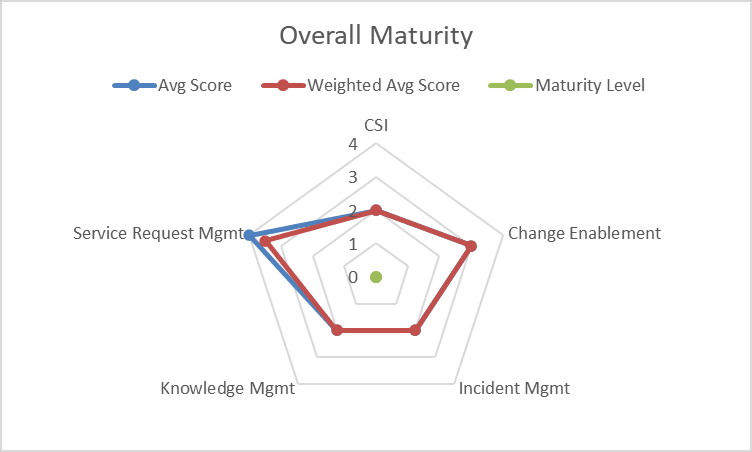
One can now look at the radar map displayed above and make a decision of where they are. In the example above the result is dismissal. Lots more work needs to be done.
Conclusion: ITIL 4 Maturity Is About Value, Not Labels
An ITIL 4–aligned ITSM maturity assessment is not about achieving the highest score—it is about understanding capability, enabling value, and improving deliberately. When ITSM maturity assessments are grounded in ITIL 4 principles, they move beyond checklists and become powerful tools for transformation.
Organizations that succeed are those that:
- Measure what matters
- Improve where it counts
- Aligning ITSM maturity with business outcomes
- Embed continual improvement into everyday operations
Does your organization still operate in a reactive ITSM model?
Many organizations invest in ITSM tools but continue to struggle with inconsistent processes, missed SLAs, poor reporting, and heavy reliance on manual workarounds. Without a clear understanding of your current state, scaling operations or justifying further investments becomes difficult.
This is where a structured ITSM maturity assessment framework and expert-led ITSM maturity assessment services make a measurable difference.
At Scrumbyte, we provide ITSM maturity assessment consulting to evaluate your current capabilities across critical processes such as Incident Management, Change Management, Service Request Management, and SLA Management. Our ITSM assessment services combine industry best practices with practical implementation experience to deliver a comprehensive ITSM gap analysis and maturity score.
We help you identify inefficiencies, benchmark your current state, and define a clear, actionable ITSM transformation roadmap aligned to your business goals.
Whether you are planning a ServiceNow ITSM implementation, looking for a ServiceNow maturity assessment, or aiming to optimize your existing processes, our ITSM consulting services are designed to move your organization from reactive operations to a scalable, value-driven IT service management model.
Contact our team for a professional ITSM maturity assessment service and start building a high-performing ITSM ecosystem
FAQ
What is an ITSM Maturity Assessment?
An ITSM Maturity Assessment evaluates how effectively your IT service management practices are defined, adopted, and governed. It helps you understand your current maturity level and identify improvement areas across key ITSM processes.
How should the results of the maturity assessment be used?
The results are intended to support internal decision-making, improvement planning, and prioritization. They help organizations identify focus areas before investing time or resources into process redesign or tool changes.
Is this assessment aligned with ITIL® 4 and modern ITSM practices?
Yes. The assessment is aligned with ITIL® 4 concepts, including value streams, continual improvement, and outcome-based service management, ensuring relevance to modern IT environments.
How is an ITSM maturity assessment different from an audit?
Unlike an audit, a maturity assessment is diagnostic and improvement-focused. It highlights strengths and gaps without compliance pressure, enabling teams to plan realistic and prioritized improvements.
Who typically benefits most from an ITSM maturity assessment?
IT leaders, service managers, process owners, and transformation teams benefit most, especially when planning ITSM improvements, scaling operations, or preparing for organizational change.
How often should ITSM maturity be assessed?
Most organizations reassess ITSM maturity annually or after significant changes such as process redesign, tool implementation, or organizational restructuring. This ensures continuous alignment with business and service goals.
Can this assessment support ITSM roadmap and transformation planning?
Yes. The assessment outcomes provide clarity on current-state maturity and priority gaps, which directly support ITSM roadmap creation and phased improvement planning.
Does the assessment focus on processes, governance, or outcomes?
The assessment takes a balanced view, evaluating process design, governance effectiveness, and outcome alignment. This ensures maturity is measured not just by documentation, but by real operational effectiveness.

Vijay Chander is the founder of Scrumbyte, and is a senior IT strategy and service management consultant with over 30 years of global experience across Fortune 100 organizations including Microsoft, Caterpillar, First Data and SWIFT. He has led large-scale enterprise transformations spanning ITSM, architecture, product development, and managed services
Comments are closed