
Introduction
While we explore SLA breach, let us understand the context of its origin – SLA. A Service Level Agreement (SLA), which is part of Service Level Management Process– is a formal agreement between a service-provider and a customer that defines the services to be delivered, the performance levels expected and the consequences of failing to meet them. That is the definition, but one that hits the business is the bottom line financially – SLA penalties. It is also a document/contract that is legally binding and enforceable.
When one of those targets is not met—for example, the agreed response time or resolution time is exceeded—it constitutes an SLA breach or violation. SLA breaches are not just metrics – trust is lost, impede business outcomes and most often rather than the exception trigger financial penalties.
In IT service environment, the challenge is not only in defining SLAs but in ensuring they are met consistently. We will explore how SLA breaches come about, real-life scenarios, prevention techniques and how artificial intelligence (AI/ML) is emerging as a powerful lever to avoid breaches. We will also investigate practical steps to fix a broken SLA process.
How SLA Breaches Happen
SLA breaches occur when the defined service commitments are not fulfilled within the agreed timeframe or performance thresholds. These are the common breach types:
- Response time breaches: when a service request or incident is not acknowledged within the agreed upon period. (The easiest to fix)
- Resolution time breaches: when the issue is not resolved within the agreed target timeframe. (Depends on your team’s expertise)
- Availability / uptime breaches: when a service does not meet its promised uptime or accessibility target. (Multi-factor issues that require a deep dive)
Common SLA Breach causes
People gaps: Incorrect priorities, insufficient staffing, skill mismatches or overlooking tickets can delay acknowledgement or resolution.
Process gaps: SLAs set arbitrarily without realistic capacities, missing internal OLAs (Operational Level Agreements) between support teams, or unclear escalation paths cause delays.
Technology gaps: Misconfigured SLA rules, disconnected tools (monitoring, CMDB, ITSM platform) and lack of real-time visibility make breaches harder to detect and prevent.
For example: even with a modern ITSM platform that tracks SLA timers, a critical incident may remain unassigned because it did not match the automation criteria and thus breached the SLA.

SLA Breach examples
One way of understanding SLA Breaches is to explore various scenarios from real life examples.
Scenario 1 – High-priority incident misclassified
A senior executive’s workstation wipes out; the SLA states “P1 incidents must be responded to within 30 minutes / resolved within 4 hours”. The incident is logged as “normal” priority, not P1, due to mis-categorization – and the SLA resolution time passes.
Scenario 2 – Service request backlogs
The SLA for standard access requests is “access granted within 24 hours”. Because the service desk uses email to track requests, a handful sits unassigned in the backlog. One request cross 30 hours → SLA breach.
Scenario 3 – Uptime failure
A business-critical application had an SLA of 99.9% availability (~43 minutes downtime per month). Due to an unplanned outage of 1 hour, the availability falls to 99.8% → SLA breach triggers credits or penalties.
Scenario 4 – Third-party dependency
An SLA promise: “Vendor support within 2 hours”. The internal team waits on the vendor; but the SLA clock did not pause for “third-party response” and when the vendor finally responds the internal resolution time has breached the target.
Scenario 5 – Manual process and lack of alerts
A ticketing system supports SLA timers but lacks escalation alerts when 90% of the time passes. The technician is unaware the SLA is approaching breach → ticket resolution happens after the deadline.
In each scenario the root isn’t just a missed deadline – it’s a failure in process design, priority setting, tool configuration or visibility.
Of the scenarios above, one that often problematic is the “Third-party dependency conundrum”. Let us take a deep dive into this.
The Third-party dependency Conundrum
When drafting an SLA (Service Level Agreement) with a third-party vendor in circumstances where their performance affects your own SLA to your customer, you’ll want to include provisions that clearly allocate responsibilities, allow for penalty pass-through, and protect your contractual position. A suggested structure and sample wording you can adapt — please consult your legal counsel to tailor to your jurisdiction and situation.
Key Contractual Elements to Include
- Flow-down or “Pass-Through” Clause
- Make sure the vendor is obligated to perform at levels that enable you to meet your SLA with your customer.
- State that any failure by them which causes your breach can trigger remedies from vendor to you.
- Example reference: many contracts include “Pass-Through SLA; Warranty Disclaimer” clauses.
- Service Level Metrics, Escalations & Remedies
- Define the vendor’s metrics (response time, resolution time, availability) that map to your own customer commitments.
- Include escalation matrix and early warning triggers.
- Provide remedies for vendor breaches (service credits, financial penalties, cost recovery).
- Indemnification and Liability for Third-Party Breach
- Specify that if the vendor fails to meet their SLAs and that causes you to breach your SLA with your end customer (or incur penalties, costs, reputational damage), then the vendor must indemnify you for losses, provided you and produce proof of the same.
- Example: “An indemnification clause is… require the service provider to pay the customer any litigation costs by third parties resulting from the breach of contract.”
- Limitation of Liability and Causation Carve-out
- Ensure you have language that distinguishes vendor fault vs causes outside their control (force majeure, your own failures).
- For example: “the vendor shall not be in default … if the failure is caused by … subcontractor … unless the services were reasonably obtainable from other sources.”
- Recourse / Pass-Through of Customer Penalties
- Explicitly provide that if you incur a penalty from your customer due to vendor breach, you can recover that penalty (or portion thereof) from the vendor.
- Define the calculation, cap, and timeline.
- Audit, Monitoring & Reporting
- Vendor must provide timely performance reports, permit audits.
- Early detection gives you the ability to escalate before a full breach.
Sample Wording Snippets
Here are sample clauses you can adapt from a legal perspective:
Flow-down Obligations
“Vendor shall perform the Services in a manner that enables [Your Company] to meet its contractual SLA commitments to its Customer. Vendor acknowledges that any failure to meet the Service Levels set out herein may cause Your Company to incur SLA penalties or other liabilities to the Customer or may result in reputational damage.”
Service Level & Remedies
“If Vendor fails to achieve any Service Level in any calendar month, then Your Company]may claim from Vendor service credits or financial penalties as set out in Schedule X. The credit/penalty to Your Company]for each breach will mirror the penalty Your Company]owes the Customer, up to a cap of [Y%] of the monthly Service Fee.”
Indemnification for Customer Breach
“In addition, if Your Company]incurs any costs, damages, service credits or penalties from its Customer as a direct result of Vendor’s failure to meet its Service Levels, Vendor shall indemnify and hold Your Company]harmless for such amounts, subject to the limit of liability clause herein.”
Limitation / Exclusion of Liability
“Vendor shall not be liable for service level failures to the extent caused by (i) force majeure; (ii) failure of Your Company to perform its obligations; (iii) changes requested by the Customer that affect scope, unless agreed. Notwithstanding anything else, Vendor’s aggregate liability for all claims arising out of or in connection with this Agreement shall not exceed [Z×] times the monthly fee, or [$] X, whichever is lower.”
Audit & Reporting
“Vendor shall provide Your Company with access to its performance dashboard, reports of all incidents, root-cause analyses for any Service Level exceedance, and audit rights on demand. Vendor will also utilize early-warning alerts at 75% and 90% of SLA target times.”
SLA Breach best practices to Ensure Coverage
- Align your vendor’s SLA metrics exactly with your customer SLA commitments.
- Define clear causation links: vendor failure → your failure → customer penalty.
- Cap liabilities but make the pass-through of customer SLA penalties clear.
- Build in early-warning triggers so you can act before full breach.
- Ensure third-party vendor contracts themselves include upstream “pass-through” to you, so you’re not left chasing liability up the chain.
- Maintain detailed documentation of any incident-to-breach timeline for audit / claim purposes.
- Periodically review SLAs and renegotiate when business or tech changes.
The Impact of SLA Breaches
- Customer dissatisfaction & reputational damage: When services don’t meet expectations, trust erodes.
- Financial consequences: Many SLAs include service level credits, penalties or contract termination rights in case of repeated failures.
- Business disruption: Delayed access, failed incidents or application downtime directly impact productivity and revenue.
- Internal demotivation and cost increase: Teams working under constant pressure of missed SLAs may burn out; committees and rework add overhead.
- Hidden backlog (‘watermelon effect’): Tickets move to “On-Hold” status just before SLA breach triggers, so metrics look green externally, but user experiences remain poor.
How to prevent SLA Breaches
To reduce breaches, you must treat the problem proactively—not just react when a breach occurs. Below are proven strategies:
1. Set realistic SLAs aligned with capacity
Work closely with business stakeholders and IT operations to define targets that reflect actual capacity, complexity and skill availability. Unrealistic SLAs set you up for failure. Experience handling bad prior examples counts!
2. Build and monitor underlying OLAs/UCAs
Ensure internal teams (L1, L2, vendors) have operational-level agreements with target times that support the SLA. Without that, your end-customer SLA cannot be met.
3. Categorise and prioritise properly
Use clear criteria to assign ticket priority and map to appropriate SLA definitions. Ensure triage is accurate and quick. Mis-prioritisation is a common cause of breach.
4. Automate ticket routing and escalation
Use workflows to auto-assign based on ticket type, priority, skillset and trigger escalation warnings at 75% and 90% of SLA time.
5. Real-time monitoring and dashboards
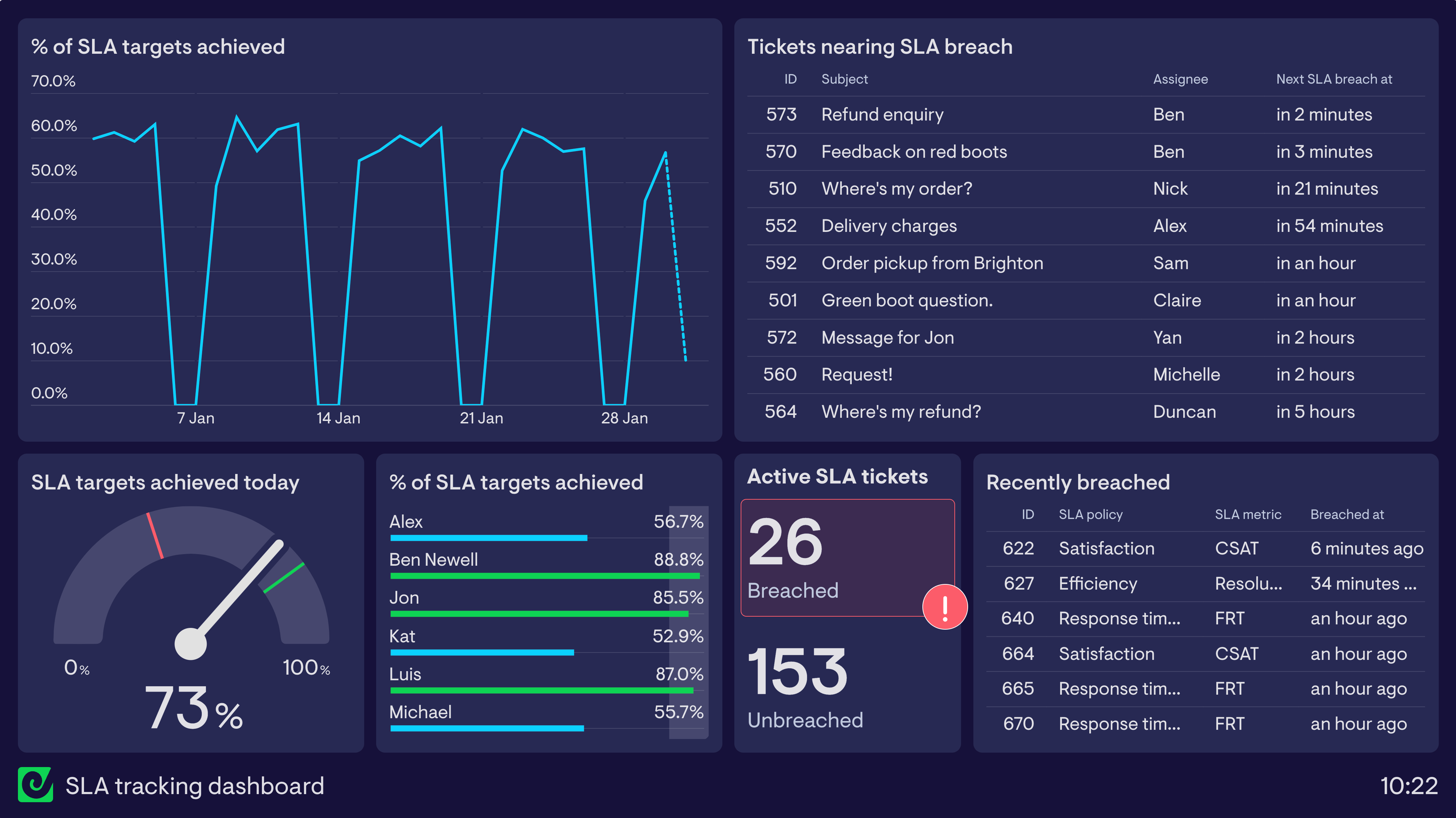
Provide views of tickets “At Risk” of breach, queue depth, hand-offs and agent workloads. Dashboards enable immediate corrective action.
6. Integrate monitoring and ITSM tools
Ensure the monitoring, alerting and ticketing systems are integrated so incidents are automatically logged, prioritised and timed appropriately. Tool gaps lead to breaches.
7. Review and continuous improvement
Hold regular SLA review meetings with business stakeholders, analyse root-causes of breaches, adjust SLAs, processes or tools accordingly. A “fix once” mindset doesn’t suffice.
8. Tailored alerts & breakpoints
Configure warning alerts before the SLA deadline (e.g., at 75% and 90%) so teams can act before an actual breach. Many systems support this out-of-box.
How AI / ML Can Help Proactively Avoid SLA Breaches
Now, embedding artificial intelligence (AI) and machine learning (ML) into SLA management in ITSM takes prevention into the future. Let us look into some of the ways as to how AI is reshaping SLAs.
- Predictive breach detection: ML models analyze historical ticket data, resource availability and trends to predict which tickets are likely to breach before they do—enabling pre-emptive action.
- Automated prioritization and routing: AI automation in ITSM can classify incidents and service requests in real-time based on urgency, customer impact and past resolution patterns—and route them correctly from the outset.
- Dynamic SLA adjustment: In complex environments, AI can suggest adjusting SLA targets based on workload, demand patterns, or seasonality—keeping promises realistic while managing expectations.
- Virtual agents/self-service bots: By handling standard requests autonomously, virtual agents reduce load on human teams and reduce risk of SLA breaches for repeatable tasks.
When properly trained and configured, these intelligent capabilities shift SLA compliance from reactive to proactive.
Fixing a Broken SLA Process — Preventive Steps
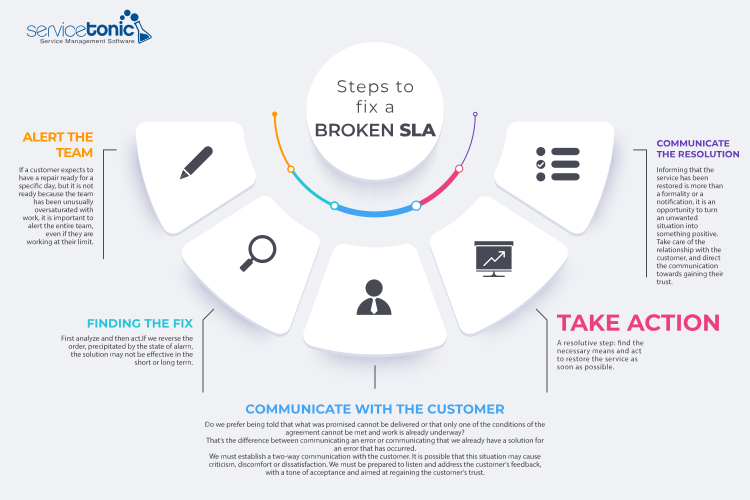
If you find that your SLAs are consistently being breached, here’s a roadmap to restoring healthy SLA compliance:
- Conduct an SLA audit
- Map all current SLAs vs actual performance.
- Identify which SLA targets are breached most frequently and why.
- Review underlying OLA/UCAs, tooling, queues and hand-offs.
- Re-engage business stakeholders
- Revalidate SLA commitments in light of actual IT capacity and business impact.
- Renegotiate targets if they’re consistently missed and misaligned.
- Simplify SLA definitions
- Reduce complexity: fewer SLA categories, fewer exceptions. Simpler rules mean easier compliance.
- Remove or pause “on-hold” loopholes that artificially delay SLA clocks.
- Improve triage and prioritisation
- Train support teams to categorise and prioritise correctly.
- Implement workflows and triggers to auto-escalate tickets nearing SLA breach.
- Enhance visibility and early warning
- Introduce dashboards showing tickets at risk of breach.
- Set warning alerts at 70-80% of SLA time and immediate escalation at 90%.
- Align people-process-technology
- Ensure skill levels match the ticket demands.
- Improve tooling: ensure ticketing system, monitoring, CMDB are integrated.
- Remove process bottlenecks: approvals, hand-offs, third-party delays.
- Embed continuous improvement
- Hold monthly or quarterly SLA reviews with business.
- Analyse root causes of breaches and feed improvements into process and tooling.
- Monitor metrics such as first-contact resolution, queue-ages, hand-offs.
- Leverage automation and AI
- Automate routine tasks (ticket routing, alerting, status updates).
- Use AI to forecast risk of breach and allocate resources proactively.
- Monitor and refine AI models as the environment evolves.
Conclusion
SLA breaches are not merely missed deadlines—they are a symptom of deeper misalignment among service promise, capacity, process and tooling. While modern ITSM tools automate much of the mechanics, breaches still occur if the underlying people, processes and data architecture are not aligned. By choosing realistic commitments, mapping internal dependencies, monitoring early warning indicators and integrating AI-driven intelligence, organisations can reduce SLA breaches, deliver dependable services, build stronger trust, and ultimately, support business outcomes more reliably.
In an environment where services are the backbone of business operations, proactive SLA management is a competitive differentiator—not just an operational necessity.
How Scrumbyte Helps Reduce SLA Breaches
At Scrumbyte, sustainable SLA improvement comes from fixing processes – not just configuring tools.
Through our ITSM consulting services, we help organizations uncover root causes and improve outcomes using a structured approach that combines SLA management consulting services with focused SLA breach reduction consulting.
Our strength lies in ITSM process redesign consulting – streamlining workflows, fixing ownership gaps, and aligning SLAs with real business priorities.
Outcome
- Fewer SLA breaches
- Faster resolution times
- Improved SLA compliance and service reliability

Vijay Chander is the founder of Scrumbyte, and is a senior IT strategy and service management consultant with over 30 years of global experience across Fortune 100 organizations including Microsoft, Caterpillar, First Data and SWIFT. He has led large-scale enterprise transformations spanning ITSM, architecture, product development, and managed services

Comments are closed